
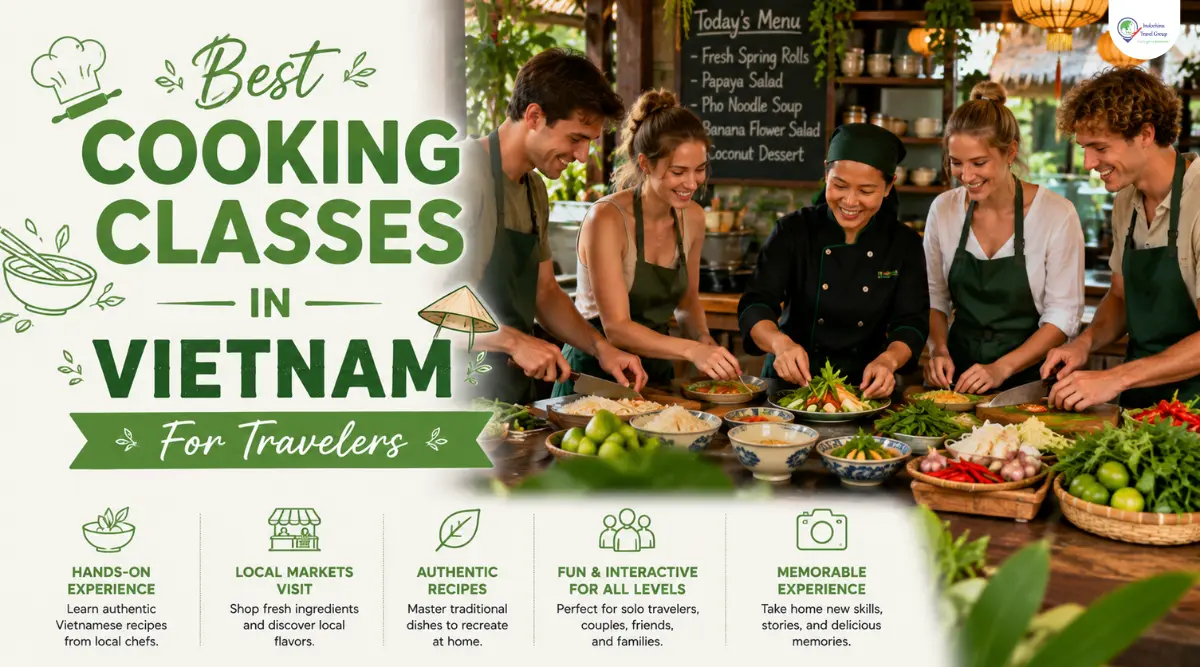
A cooking class in Vietnam makes sense when you want more than a meal: you want to handle ingredients, practise a few techniques, understand how a dish comes together, or spend part of the day on a slower food experience. The useful choices are practical—which city, what class format, how hands-on it really is, what menu you will cook, group size, dietary needs and how much time the experience takes. For street eating, use the Street Food in Vietnam guide; for broader activity planning, start with Things to Do in Vietnam.
Decide what you want to learn before choosing a class
A cooking class is not compulsory for understanding Vietnamese food. It earns a place in the itinerary when the hands-on part matters to you: learning how a particular dish is prepared, recognising herbs or sauces, comparing regional techniques, or taking home a repeatable recipe.
If you mainly want to taste several dishes without spending half a day cooking, a street-food walk or market meal may fit better. If you already cook regularly, look for a smaller class with more technique and less demonstration. If the group includes children, mobility constraints or strict dietary needs, the kitchen setup and instructor support matter more than a scenic setting.
Check what the class actually includes
Cooking-class formats vary widely. Do not assume every class includes a market visit, hotel transfer, full hands-on preparation or the same number of dishes.
Market or ingredient visit
Useful when ingredient selection is part of what you want to learn. Confirm whether this is a real guided market segment or simply a short walk before the kitchen session.
Hands-on cooking
Check which dishes you prepare yourself, which steps are demonstrated, whether participants share stations, and how much knife, wok or stove work each person actually does.
Meal, recipes and follow-up
Most classes finish by eating the prepared dishes, but recipe notes, drinks, leftovers and digital follow-up vary. Confirm these inclusions if recreating the food at home is one of your goals.
Choose the city from the route, then compare class formats
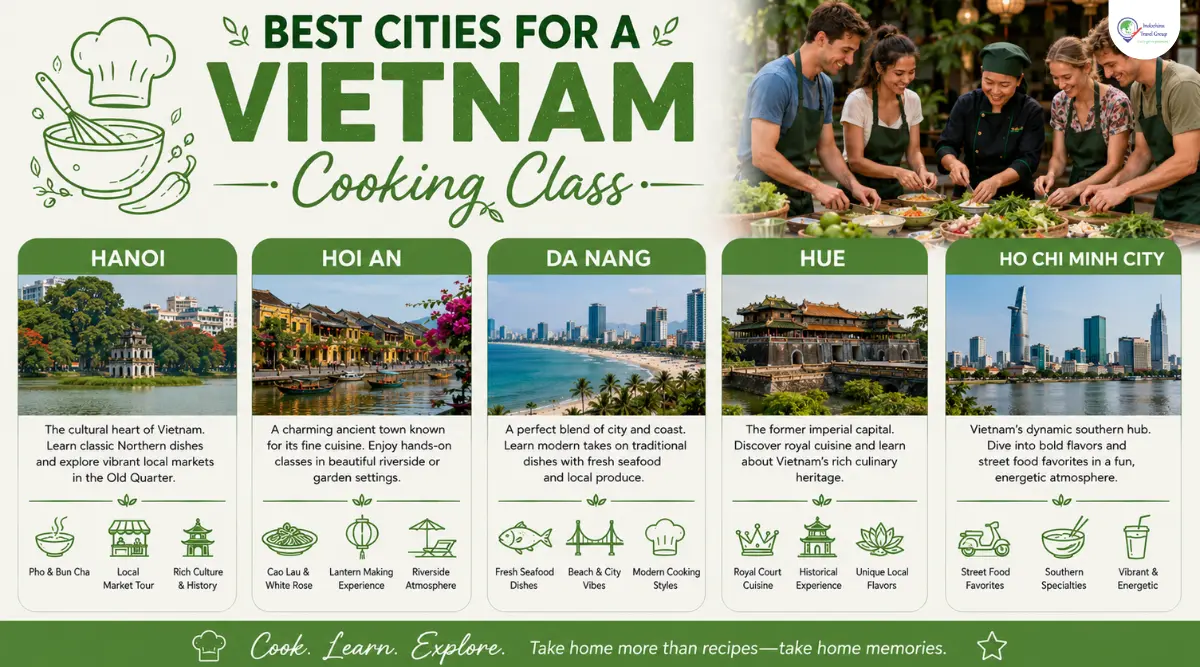
The best city for a class is usually the city already on the itinerary. That keeps the food experience from creating an extra transfer and lets the menu reflect dishes you may also encounter locally.
Hanoi
Useful when you want northern dishes or a class that fits around an Old Quarter or heritage stay. Compare class location, market component and whether the menu actually matches your interest.
Hoi An
Hoi An has many city, countryside and garden-based options. A boat, village or farm component should be chosen because that setting adds value, not because it is automatically more “authentic”.
Hue
Hue is worth comparing when the route already includes the former imperial capital and you want the class to stay focused on central-Vietnam dishes. Check whether the menu is genuinely Hue-led or simply a general Vietnamese set sold in Hue.
Ho Chi Minh City
City-based classes can fit well into a shorter urban stay. Check district, transfer time and class length carefully because a cross-city movement can consume a large part of the day.
Compare class formats by learning value and logistics
Market-to-kitchen
Choose this when ingredient identification and market context matter. It usually takes more time than a kitchen-only lesson and may involve walking in heat or crowded spaces.
Home-style or small-group kitchen
Useful when you want more conversation and hands-on time. Check group size, kitchen layout and whether each participant has their own workstation.
Restaurant or cooking school
Often easier when you want a structured setup, clearer facilities or a shorter city-based session. The trade-off is that the experience may feel more formal and less connected to a market or neighbourhood.
Countryside or farm setting
Works when the agricultural setting is genuinely part of the interest. Count the extra transfer, outdoor conditions and activity length before choosing it over a city class.
Choose the menu by the techniques you want to practise
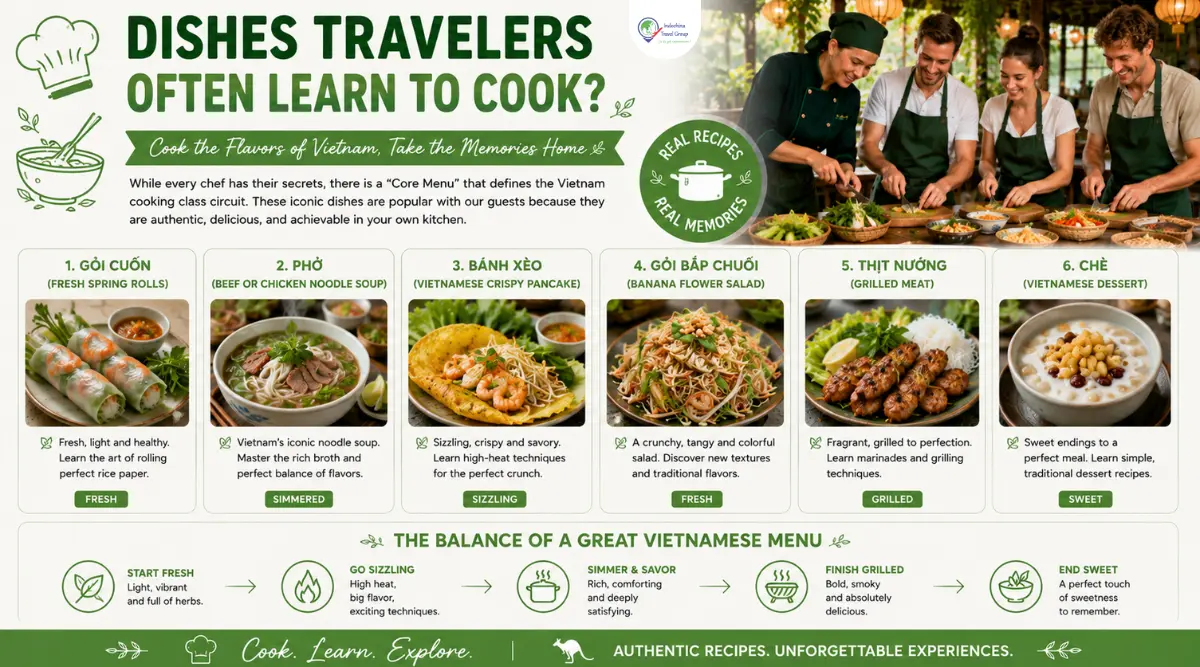
Menus often include familiar dishes such as fresh or fried rolls, bánh xèo, salads, noodle dishes or regional specialities, but there is no national “core menu” every class should teach. A better comparison is the technique you want to practise and whether the recipe is realistic for your home kitchen. If several dish names are still unfamiliar, skim the Vietnamese dishes guide first so you can choose a menu for what you actually want to learn rather than for the longest list.
- Rice-paper and wrapping: useful if you want a repeatable hands-on technique.
- Wok or pan cooking: useful when heat control and timing are part of the learning goal.
- Broths and sauces: useful for understanding seasoning, but check how much is pre-prepared before the class.
- Regional dishes: useful when the class is tied to a specific city and you want more context for food you are already eating there.
Judge the class by instruction, participation and fit
A strong class should make clear what you will do, how much instructor support is available and whether the kitchen setup fits the group. “Authentic” or “local” labels are less useful than concrete details.
Check: group size, language support, hands-on versus demonstration time, menu flexibility, dietary handling, kitchen accessibility, transfer time and what is included in the price.
If you want deep technique, ask whether ingredients or sauces are prepared before participants arrive. If the class is mainly for a relaxed activity, a simpler menu and clearer pacing may be more valuable than a longer list of dishes.
What families, dietary needs and accessibility change
| Need or constraint | What to check | Why it matters |
| Short city stay | Location, start/end time, transfer included or not | A good class can still be a poor fit if it consumes two extra hours in transport |
| Children | Minimum age, stove/knife participation, class length | “Family friendly” is too vague without knowing what children actually do |
| Mobility or accessibility needs | Stairs, standing time, market walking, toilet access, transport | Countryside and market formats can add physical demands that a kitchen-only class avoids |
| Vegetarian, vegan or allergies | Menu substitution, shared equipment, cross-contact communication | A class can modify one dish without being able to control cross-contact across the kitchen |
| Serious cooking interest | Group size, prep done in advance, instructor access, technique depth | More dishes do not automatically mean more learning |
A quick way to compare two similar classes
City → format → menu → group size → dietary/accessibility needs → inclusions → transfer time → recent reviews. That sequence is more useful than choosing from a “best cooking classes” ranking.
Recent reviews are most useful when they describe concrete details such as class size, instructor clarity, pickup reliability, market walking, hygiene, dietary handling and how much cooking participants actually do. A recipe sheet or digital follow-up is useful when recreating the dishes at home matters, but it should not outweigh a poor class format.
How much of the day should a cooking class take?
The advertised class time is only part of the decision. Add the market walk, hotel pickup or meeting-point travel, countryside transfer and the meal at the end before deciding what else belongs on the same day.
- Short workshop: useful when you mainly want one or two techniques and need to protect sightseeing time.
- Half-day class: the most practical shape when you want a market component, several dishes and enough hands-on time without giving the whole day to food.
- Longer countryside experience: worthwhile when the farm, garden, boat or village setting is part of the reason you are booking, not just an add-on to the kitchen session.
Do not compare two classes by the cooking hours alone. A three-hour class ten minutes from the hotel can be easier to fit than a nominally shorter experience with long transfers.
Compare current price and inclusions, not an old average
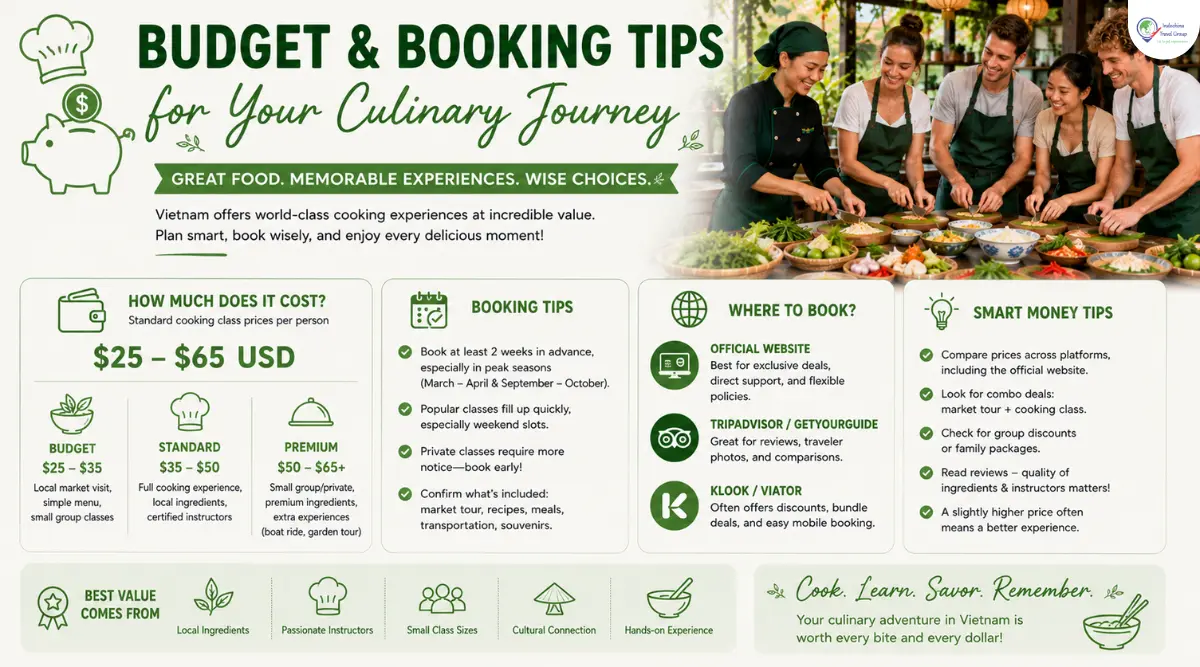
Cooking-class prices change by city, format, group size and what is included. Rather than freezing one USD range into the article, compare the current price against the actual experience: market visit, transfers, number of dishes, private versus shared class, drinks, recipes and any countryside activity.
Book earlier when a specific small-group class, language, dietary setup or date is important. If the group is flexible, there is less reason to lock a generic class weeks ahead simply because it is “peak season”. Check the operator’s own cancellation terms and current availability before paying.
Let the class anchor one part of the day
A class that includes a market and meal can already occupy a substantial part of the day. Avoid stacking another food tour immediately afterwards unless food is intentionally the main purpose of that day.
Use a nearby, lower-effort afternoon activity after the meal. Keep the evening flexible rather than assuming the group will want another large food experience.
Keep the morning in the same district or allow enough transfer buffer. A distant sightseeing stop immediately before class can make the day feel rushed.
Count the road or boat transfer as part of the activity. Do not treat the return journey as unused time that can automatically hold another major attraction.
A good class should make the rest of the food trip easier
The most practical benefit is not a promise of “deep cultural connection”. It is better recognition of ingredients, techniques and dishes you encounter afterwards. That can make menus less confusing and help you decide which street-food or restaurant experiences deserve more time.
A class does not certify the hygiene or safety of unrelated street vendors, and it does not turn a traveller into a local expert. Keep the learning specific to what the instructor actually teaches.
Choose the class that fits the route and the learning goal
A strong Vietnam cooking class is the one that matches your city, available time, menu interest, participation level and dietary or accessibility needs. Compare concrete inclusions and recent reviews, then choose whether the hands-on experience is worth the block of time it takes from the rest of the itinerary.
If you want the food experience placed inside a wider route, compare our Vietnam Tour Packages as starting structures rather than choosing the class first and forcing the itinerary around it.

Recommended Tours

Group Tour
Hanoi – Sapa – Danang – Ho Chi Minh 10D9N
Hanoi - Sapa - Fansipan Peak - Ninh Binh - Halong Bay Overnight On Cruise - Danang - Hoi An Ancient Town - Bana Hills - Golden Bridge - Ho Chi Minh - Cu Chi Tunnels - Mekong Delta



Private Tour
Ho Chi Minh – Cu Chi Tunnels – Mekong Delta 4D3N
Ho Chi Minh - Cu Chi Tunnels - Mekong Delta


Private Tour
Vietnam Highlights 7 Days 6 Nights Tour
Hanoi Arrival - Hanoi City Tour - Ha Long Bay Day Cruise - Fly to Da Nang - Coconut Village - Hoi An Ancient Town - Ba Na Hills - Golden Bridge - Fly to Ho Chi Minh City - Cu Chi Tunnels - Mekong Delta - Departure


5D4N DELIGHT DANANG TOUR (DANANG – BA NA HILL FRENCH VILLAGE – HOI AN – HUE CITY) (SEAT IN COACH)


Private Tour
Vietnam Panorama Discovery 16D15N
Ho Chi Minh - Cu Chi Tunnels - Mekong Delta Tour - Can Tho - Da Lat - Nha Trang - Hoi An - Da Nang - Hue - Hanoi - Halong Bay Overnight On Cruise