
How much does a trip to Vietnam cost? For in-country spending, a practical planning range is about US$25–60 per person/day for budget travel, US$60–150 for a comfortable independent trip, and US$150–300+ for private or higher-comfort travel. International flights are separate, and an overnight cruise, premium resort or several domestic flights can push the average higher.
The daily figure is only a starting point. Your total changes most with hotel category, how many regions you cover, domestic transport, cruise cabin, private versus shared services and the number of paid activities. A slower trip through one region can cost less than a shorter itinerary that uses several flights and one-night stops.
What usually makes a Vietnam trip expensive?
For most travellers, everyday meals and short city rides are not the main budget risk. The larger jumps usually come from accommodation, long-distance transport and a small number of high-cost experiences.
- Accommodation: location, room category and peak dates can change the total quickly.
- Long-distance transport: several domestic flights, airport transfers or private road sectors add up faster than local transport.
- Overnight cruises and resorts: the cabin or room category can move the trip into a different budget band.
- Private guiding and specialist activities: multi-day trekking, caving or fully private touring should be priced separately from ordinary daily spending.
Use the Vietnam Travel Guide for the wider planning layer. This page stays focused on budget and trip cost.
Vietnam travel cost per day: useful planning bands
Daily-cost estimates vary because some guides count only independent day-to-day spending, while others include guided services, domestic flights or higher-category hotels. For a first planning pass, excluding international airfare:
| Travel style | Planning range per person/day | What the band usually assumes |
|---|---|---|
| Budget | About US$25–60 | Simple rooms, local meals, public/shared transport and mostly self-guided sightseeing |
| Comfortable independent | About US$60–150 | Private room or 3–4 star hotel, paid activities, some domestic transport and more flexibility |
| Private / higher comfort | About US$150–300+ | Private guide or vehicle on selected days, higher-category hotels or cruises, resorts and premium activities |
These are planning bands, not ITG package prices. They work best for deciding whether a route is broadly affordable. A premium Ha Long cruise, Phu Quoc resort, specialist cave trip or several domestic flights can lift the average sharply.
Why an independent budget and a private-tour budget look different
An independent daily budget usually counts the room, meals, local transport and tickets you pay as you go. An organised or private itinerary may also bundle airport transfers, guides, vehicles, domestic flights, cruise cabins, entrance fees and some meals into the quoted price. Compare the inclusions before comparing the daily average; otherwise two trips with similar routes can look artificially far apart.
How much should you budget for 7, 10 or 14 days in Vietnam?
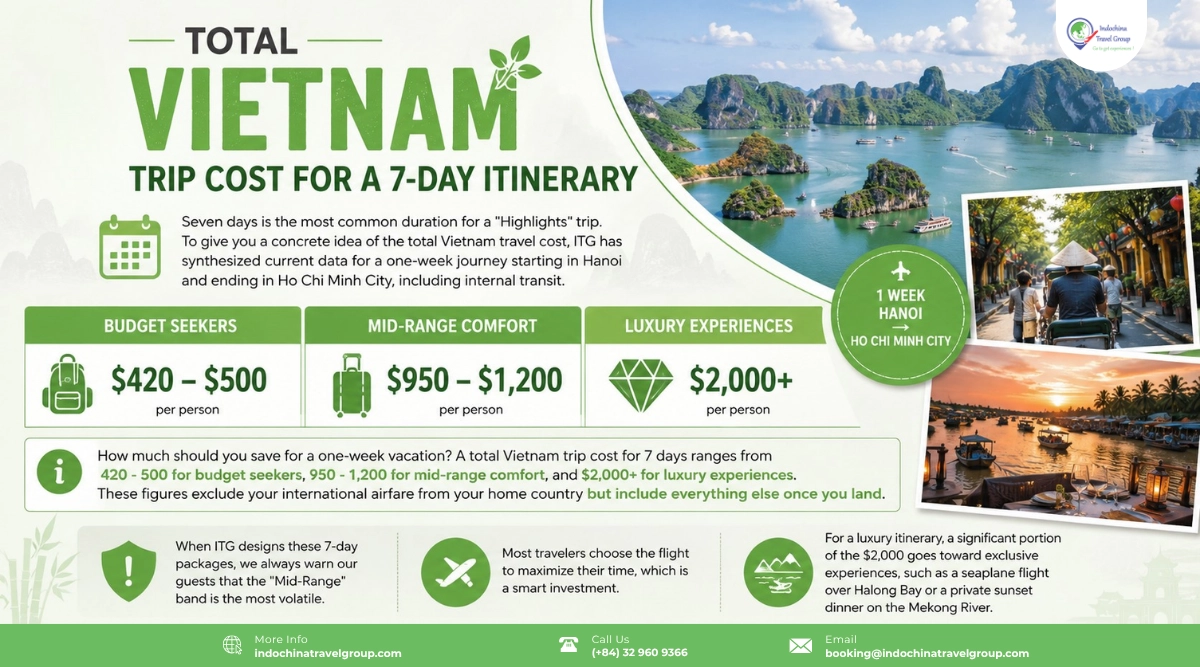
The simplest estimate is daily band × usable travel days, then add any large one-off items that sit outside ordinary daily spending. Route design matters: a single-region trip with few hotel changes can cost less than a shorter route using several flights.
| Trip length | Budget | Comfortable independent | Private / higher comfort |
|---|---|---|---|
| 7 days | About US$175–420 | About US$420–1,050 | About US$1,050–2,100+ |
| 10 days | About US$250–600 | About US$600–1,500 | About US$1,500–3,000+ |
| 14 days | About US$350–840 | About US$840–2,100 | About US$2,100–4,200+ |
These figures exclude international airfare and should not be read as quotes. For the route side of the decision, compare the 7-day, 10-day and 14-day Vietnam itineraries; then price the hotels, transport and experiences that those routes actually require.
Accommodation: usually the largest budget lever
Accommodation can change the total more than most everyday expenses. Decide the hotel level first, then compare room type, location, breakfast, peak-date supplements and whether a resort stay is part of the route.
- Simple guesthouse or hostel: useful for travellers prioritising location and price over facilities.
- 3–4 star hotel: often the most practical middle ground for first-time visitors.
- 5-star or resort stay: can materially change the total, especially in beach destinations and peak periods.
Do not compare only the headline room rate. A centrally located hotel that reduces transfers can sometimes be better value than a cheaper property farther away.
Transport: price the route, not each ticket in isolation
Vietnam is long, so transport choices affect both budget and usable sightseeing time. Domestic flights, trains, private cars, shared transfers and overnight buses can all make sense in different routes.
- Use flights when they save a meaningful travel day between distant regions.
- Use trains when the journey itself fits the pace of the trip.
- Use private vehicles for regional sectors where door-to-door timing matters.
- Compare baggage rules and airport transfers when evaluating a low headline airfare.
For a package itinerary, check whether each domestic flight or transfer is included before comparing totals between suppliers.
Tours and activities: identify the high-cost experiences first
Most sightseeing tickets are not what makes a Vietnam trip expensive. The larger cost differences usually come from overnight cruises, private guides, specialist activities, premium boats, multi-day trekking or excursions that require substantial transport.
Before setting a daily budget, list the experiences you consider non-negotiable. Price those first, then build normal meals, local transport and smaller entrance fees around them.
When comparing trip costs, separate the route itself from optional upgrades and private experiences. A longer transfer, private guide, higher hotel category or overnight cruise can change the quotation more than the entrance fee to an individual attraction. Compare our Vietnam tour packages by route and inclusions rather than relying on one generic daily budget.
Season and destination can change the same itinerary’s price
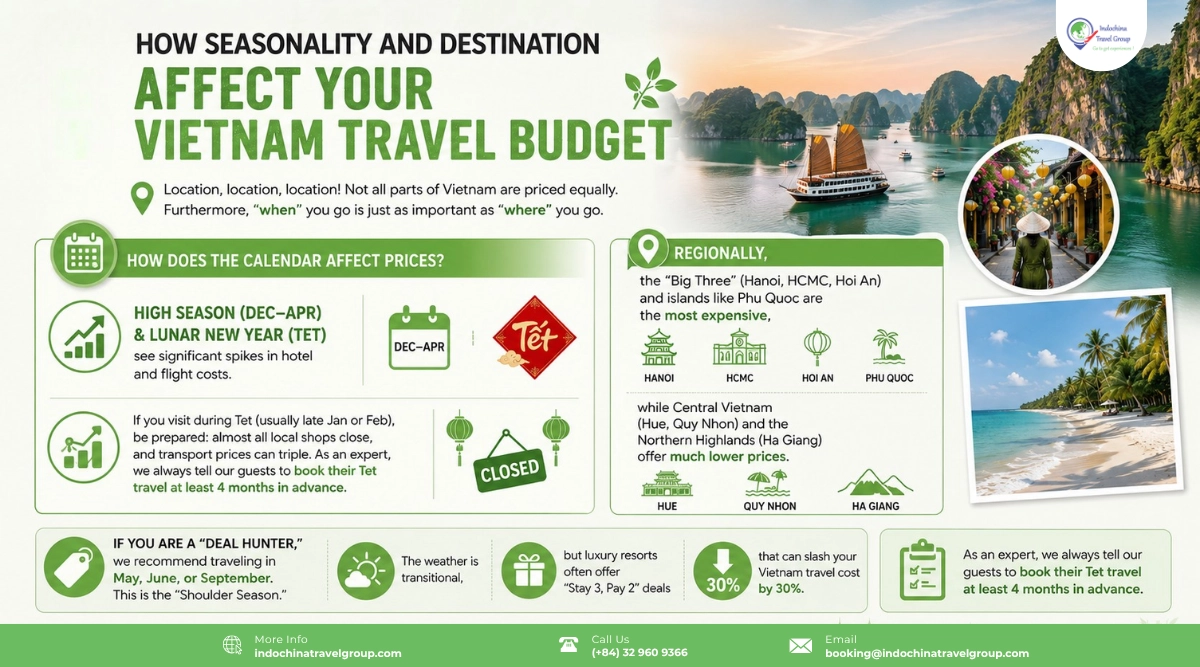
Hotel and transport rates are dynamic. Holiday periods, major local events, school-holiday demand, Tet, beach season and limited room inventory can all affect the same route differently from one month to another.
Instead of relying on a fixed “high-season surcharge”, compare the actual dates you intend to travel. If the budget is tight, changing the hotel level, removing one flight sector or shifting the trip by a few days can matter more than cutting small daily expenses.
Do not forget entry, insurance and personal-spending costs
Your in-country travel budget may not include every pre-trip or personal expense. Keep a separate allowance for:
- International flights and checked baggage
- Visa or entry-permission costs that apply to your passport
- Travel insurance and any relevant medical coverage
- SIM/eSIM or roaming
- Laundry and personal shopping
- Tips and meals not listed in the itinerary
- Optional activities added after booking
Use the Vietnam visa guide for the entry-cost layer, the Vietnam travel insurance guide for policy questions, and the Vietnam currency guide for cash, cards and exchange. Recheck current provider or official prices close to booking instead of carrying an old fixed fee into the trip budget.
Build your Vietnam budget from five cost buckets
| Cost bucket | Questions to answer |
| Accommodation | Hotel category, room type, breakfast, resort or city location? |
| Transport | How many flights, trains, private transfers and airport transfers? |
| Experiences | Overnight cruise, private guide, trekking, cooking class, specialist activity? |
| Food | Which meals are included and how often do you expect to dine at higher-end restaurants? |
| Personal / pre-trip | International flight, insurance, entry costs, shopping, tips, SIM and optional extras? |
This framework is more reliable than copying someone else’s daily total because it follows the exact route and service level you plan to buy.
How to reduce the trip cost without making the route worse
- Reduce unnecessary hotel changes: fewer transfer days can save both money and usable holiday time.
- Choose where private service matters: use private transport or guiding selectively instead of automatically upgrading every day.
- Compare inclusions, not only package totals: check domestic flights, cruise cabin, guide days, meals and entrance fees.
- Book high-demand components earlier: this is particularly useful for limited cruise cabins, resorts and peak-date rooms.
- Keep optional spending separate: shopping, nightlife and add-on activities should not distort the core trip budget.
Start with the route, then set the budget
There is no single correct cost for a Vietnam trip. A useful planning budget starts with the number of regions, hotel level and transport style, then adds the experiences that matter to you. If you are comparing an organised itinerary, use the confirmed quotation to see exactly which major costs are already included.
For route-level comparisons, browse our Vietnam Tour Packages and compare duration, travel style and inclusions before deciding whether the total matches your budget.

Recommended Tours

5D4N HANOI + SAPA VALLEY + SUN WORLD FANSIPAN LEGEND – LIMOUSINE VAN (SEAT IN COACH)


Private Tour
Vietnam And Cambodia Discovery 18D17N
Hanoi - Ha Giang (The Far North) - Halong Bay - Hoi An - Hue - Ho Chi Minh City - Mekong Delta - Siem Reap (Angkor)

6D5N HANOI + HALONG BAY (OVERNIGHT ON CRUISE) + SAPA VALLEY (SEAT IN COACH)

7D6N DISCOVER HANOI – HALONG – SAPA – TAM COC / NINH BINH (SEAT IN COACH)


Private Tour
Grand Tour Of Indochina 22D21N
Ho Chi Minh - Cu Chi Tunnels - Mekong Delta Tour - Hoi An Ancient Town - Hue - Hanoi - Mai Chau - Halong Bay Overnight On Cruise - Luang Prabang - Vang Vieng - Vientiane - Phnom Penh - Siem Reap - Angkor Wat - Tonle Sap Lake


Hanoi – Halong Bay – Bai Dinh – Trang An 5D4N
Hanoi - Halong Bay - Bai Dinh - Trang An