

Ha Long Bay seasons at a glance
| Period | Typical planning advantage | Main trade-off |
| March–May | Milder temperatures and often comfortable outdoor conditions | Weather can still change; do not treat every spring day as clear-sky cruising |
| June–August | Warmer weather and stronger swimming appeal | Heat, humidity and higher storm-disruption risk require more flexibility |
| September–November | Often a strong balance of temperature and visibility | Early autumn can still be affected by tropical weather systems |
| December–February | Cooler temperatures and a different, mistier atmosphere | Less swimming appeal; fog can reduce long-distance views |
Why timing matters for a Ha Long Bay cruise
Ha Long Bay cruising is more weather-sensitive than an ordinary city stay because wind, visibility, sea state and local operating decisions can change outdoor activities or the sailing plan. The useful question is therefore not “Which month is guaranteed best?” but “Which weather trade-off matters most to this trip?”
Travellers who care most about swimming may accept more heat. Travellers who prioritise deck time or photography may prefer cooler conditions even if mist is possible. Anyone with a tight onward flight should pay particular attention to the cruise’s weather-disruption and rebooking terms.
Seasonal patterns help narrow the dates, but the short-range marine forecast and current operator notice matter more than a long-range promise. Use those short-range conditions to decide whether the planned cruise activity still makes sense.
Ha Long Bay seasons: useful trade-offs
Spring and autumn are often comfortable for cruising, but neither should be sold as guaranteed clear-sky periods. Summer can support swimming and longer daylight but brings more heat and a greater need for weather flexibility. Winter can be cooler and mistier, which changes the value of outdoor deck time and water activities.

| Period | What may work well | Main trade-off |
| Spring | Milder deck time, cave visits, mixed indoor/outdoor activities | Mist, humidity and day-to-day visibility can still vary. |
| Summer | Warmer water and longer daylight | Heat, heavy rain and tropical-weather disruption require more flexibility. |
| Autumn | Often comfortable for deck time and sightseeing | Conditions still vary; do not book on the assumption of guaranteed clear skies. |
| Winter | Cooler deck weather and a different misty atmosphere | Swimming may matter less and distant views can be reduced on foggy days. |
Spring
Spring can suit travellers who want milder outdoor conditions than midsummer. Mist, drizzle and humidity remain possible, so visibility should be treated as variable rather than promised. Keep kayaking, cave visits and deck time flexible around the day’s operating plan.
Summer
Summer can make swimming and water-based activities more appealing, but heat and storm-related disruption become more important planning factors. Travellers with fixed international connections should leave enough buffer to cope with a sailing change or cancellation.
Autumn
Autumn is often comfortable for mixed cruise activities, but weather still needs a short-range check. If a particular cabin category or ship matters, book for the vessel and cancellation terms rather than because a month has been labelled “prime time.”
Winter
Winter can be cooler and sometimes misty. That can suit travellers who value indoor comfort, slower deck time and cave visits more than swimming. Cabin heating, enclosed lounges and the amount of indoor public space become more relevant when choosing the ship.
How to use the calendar without overpromising the weather
Month labels are useful for broad planning, but they should not be treated as a performance score. A cruise date can still differ sharply from the seasonal average, especially when visibility or tropical weather is involved.
- Late winter and spring: plan for variable mist, humidity and warming temperatures.
- Early and midsummer: plan around heat, rain and the possibility of weather-related operational changes.
- Autumn: often useful for mixed sightseeing and deck time, but still check the actual forecast close to departure.
- Early winter: cooler conditions make cabin comfort and indoor space more important, while swimming may become secondary.
If the cruise is the centrepiece of a short Vietnam trip, keep the Hanoi–Ninh Binh sequence flexible enough to absorb a change instead of depending on one “perfect” sailing day.
How cruise type and length change the weather decision
Boat design and itinerary length matter because a traveller spending one day on the bay has different priorities from someone sleeping onboard for two nights.
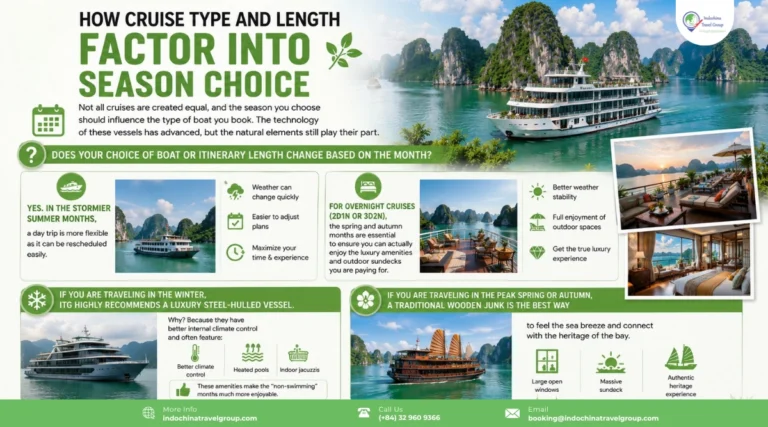
| Trip type | What to check | Weather-sensitive point |
| Day cruise | Embarkation time, cave/kayak plan, Hanoi transfer | A late operational change can affect the entire day because there is little buffer. |
| 2D1N | Cabin comfort, indoor lounges, route, inclusions | Outdoor activities may change while the overnight stay still runs. |
| 3D2N | What the second day actually adds | More time gives a slower pace but also more exposure to changing conditions. |
In cooler periods, enclosed lounges, cabin climate control and indoor facilities can matter more. In hotter periods, shade, pool design and how much of the itinerary is exposed outdoors become more relevant. Choose the vessel by the actual features and route rather than assuming steel or wooden construction automatically suits one season better.
For vessel, route and duration decisions in more detail, use the Ha Long Bay Cruise Guide.
What to pack by season for a Halong Bay Cruise
What should be in your suitcase? For Spring/Autumn, focus on light layers and a windbreaker. For Winter, you will need a medium jacket and scarves for the chilly morning air on the water. For Summer, bring high-SPF sunscreen and quick-dry fabrics, plus a sturdy waterproof bag for your phone during kayaking.Expert packing checklist- Spring/Autumn: Swimwear + a light cardigan for the evenings when the sea breeze picks up.
- Winter: A warm fleece or light down jacket. The temperature on the water feels 3-5 degrees colder than in Hanoi.
- Summer: Two swimsuits (one will never dry in the humidity!), a wide-brimmed hat, and a reusable water bottle to stay hydrated.
- Year-round: Sturdy sandals with good grip. The limestone in the caves can be very slippery when damp.
How to book and when to book your cruise
If your travel dates are fixed, you need a particular cabin type or you are travelling in a busy period, start comparing cruises earlier rather than relying on a last-minute price. In more changeable weather periods, the cancellation and rebooking policy matters even more.Before payment, ask what happens if sailing is suspended: refund, date change, alternative land arrangement or another option. The answer should be clear in writing. Price matters, but so does knowing what happens when weather changes the plan.READ MORE: How Much Does A Trip To Vietnam Cost?
How we use the weather forecast in a real itinerary
We do not rebuild an entire Vietnam trip around one long-range Ha Long forecast. Instead, we choose a sensible seasonal window, book a cruise with clear disruption terms and keep the surrounding Hanoi/Ninh Binh sequence flexible enough to handle a weather change if needed.If cruise timing is the main decision, use the cruise-choice section above to narrow the vessel and route. For a wider Vietnam itinerary, compare our Vietnam Tour Packages.
Recommended Tours

Group Tour
Hanoi – Sapa – Danang – Ho Chi Minh 10D9N
Hanoi - Sapa - Fansipan Peak - Ninh Binh - Halong Bay Overnight On Cruise - Danang - Hoi An Ancient Town - Bana Hills - Golden Bridge - Ho Chi Minh - Cu Chi Tunnels - Mekong Delta

Private Tour
Ho Chi Minh – Cu Chi Tunnels – Mekong Delta 4D3N
Ho Chi Minh - Cu Chi Tunnels - Mekong Delta

Private Tour
Vietnam Highlights 7 Days 6 Nights Tour
Hanoi Arrival - Hanoi City Tour - Ha Long Bay Day Cruise - Fly to Da Nang - Coconut Village - Hoi An Ancient Town - Ba Na Hills - Golden Bridge - Fly to Ho Chi Minh City - Cu Chi Tunnels - Mekong Delta - Departure

5D4N DELIGHT DANANG TOUR (DANANG – BA NA HILL FRENCH VILLAGE – HOI AN – HUE CITY) (SEAT IN COACH)

Private Tour
Vietnam Panorama Discovery 16D15N
Ho Chi Minh - Cu Chi Tunnels - Mekong Delta Tour - Can Tho - Da Lat - Nha Trang - Hoi An - Da Nang - Hue - Hanoi - Halong Bay Overnight On Cruise