Ha Long Bay Travel Guide: Day Cruise, Overnight & Routes
Start with time, not the ship name. A day cruise can make sense when Hanoi is the main priority; an overnight cruise makes the bay part of the stay; a second night only makes sense when the wider itinerary has room for a slower programme. After choosing the length, compare the route—Ha Long, Lan Ha or Bai Tu Long—and only then the cabin and ship. For deeper cruise selection, use the Ha Long Bay Cruise Guide.Ha Long works differently as a day trip, one-night cruise or slower two-night bay stay.
Which Ha Long Bay trip fits your itinerary?
Option
Best for
Trade-off
Planning note
Day cruise
Short Hanoi itinerary or one spare day
Long round-trip transfer and less time on the water
Use it deliberately; do not add it just because Ha Long is on every first-trip checklist.
2 days / 1 night
Most first-time visitors who want the cruise itself to matter
Uses one hotel night and normally costs more than a day trip
This is the structure we usually start from when Ha Long is a main highlight.
3 days / 2 nights
Slower pace, more time away from the main port cycle
Needs enough total trip length to justify the extra night
Better on longer Vietnam itineraries; not automatically better for a short trip.
Lan Ha / Bai Tu Long route
Travellers comparing route atmosphere, embarkation point or cruise style
Day cruise → short itinerary 1 night → cruise is a main highlight 2 nights → only when the wider trip has room
2. Then choose the route
Ha Long / Lan Ha / Bai Tu Long based on the actual programme, embarkation point and activities.
3. Choose the ship last
Cabin, deck, food and onboard activities matter after the route fits your itinerary.
Ha Long Bay at a glance
For trip planning, the important decision is not whether Ha Long Bay is worth seeing; it is how you want to experience it. A day cruise gives you the limestone seascape but comes with a long out-and-back transfer from Hanoi. An overnight cruise uses more of the itinerary, yet the transfer feels more worthwhile because the boat becomes part of the stay.We therefore choose the cruise length first, then compare the route—Ha Long, Lan Ha or Bai Tu Long—and only after that look at the ship, cabin and activities. That order prevents travellers from choosing a beautiful boat that does not actually fit the route or schedule they want.
Best time to visit Ha Long Bay
Northern Vietnam’s weather changes the visibility, temperature, swimming conditions and risk of cruise disruption. We therefore treat season as a planning input rather than promising one universally perfect month. For a month-by-month breakdown, see our Best Time for a Ha Long Bay Cruise guide.
Spring (March – May): Often a comfortable period for cruising, with milder temperatures than midsummer. Visibility still varies by day, so we would not choose a cruise solely from the month label.
Autumn (September – November): Often cooler and more comfortable on deck, but visibility still changes with cloud, haze and individual weather systems.
Summer (June–August): Expect heat, humidity and a higher risk of tropical storms. Swimming conditions can be appealing on good-weather days, but cruises or individual activities may be suspended when local maritime authorities judge conditions unsafe. We therefore pay more attention to cancellation terms and itinerary buffer in this period.
Winter (December – February): Cooler temperatures and mist are common. Swimming is less appealing for many travellers, but the cruise can still work well if you are comfortable with reduced visibility on some days.
Getting to Halong Bay from Hanoi
Most Ha Long cruise itineraries begin in Hanoi. The expressway has made the road connection much easier than it used to be, but the important detail is not the distance alone: you need to arrive at the correct cruise port before the operator’s check-in cutoff. We plan the transfer backward from that embarkation time rather than treating Hanoi–Ha Long as an ordinary city-to-city journey.Road transfers from Hanoi commonly take roughly 2–3 hours depending on the pickup point, traffic and the cruise port. The transfer should be planned against the embarkation cutoff rather than treated as a flexible arrival window.When you book a cruise, the Hanoi–port transfer is one of the first things we verify because cruise check-in times leave little room for a late arrival:
Shared cruise shuttle: Often the simplest option when pickup is included and the departure point matches your Hanoi hotel.
Private car: Useful for families, larger luggage loads or travellers who need more control over pickup time.
Independent bus / coach: Can be cheaper, but confirm where it actually stops and how you will reach the correct passenger port. The extra transfer makes this less forgiving when cruise check-in is fixed.
Premium transfer options: Treat sightseeing or premium transfers as separate experiences and verify that the arrival time still matches the cruise check-in.
Top things to see and do in Halong Bay
The useful question is not how many Ha Long attractions you can collect, but which activities are actually included on your route. Cave visits, kayaking or bamboo boats, viewpoints and swimming stops vary by cruise programme, weather and operating permission. We check the daily sequence before treating any one activity as guaranteed:Sung Sot Caves
Onboard time and cruise activities
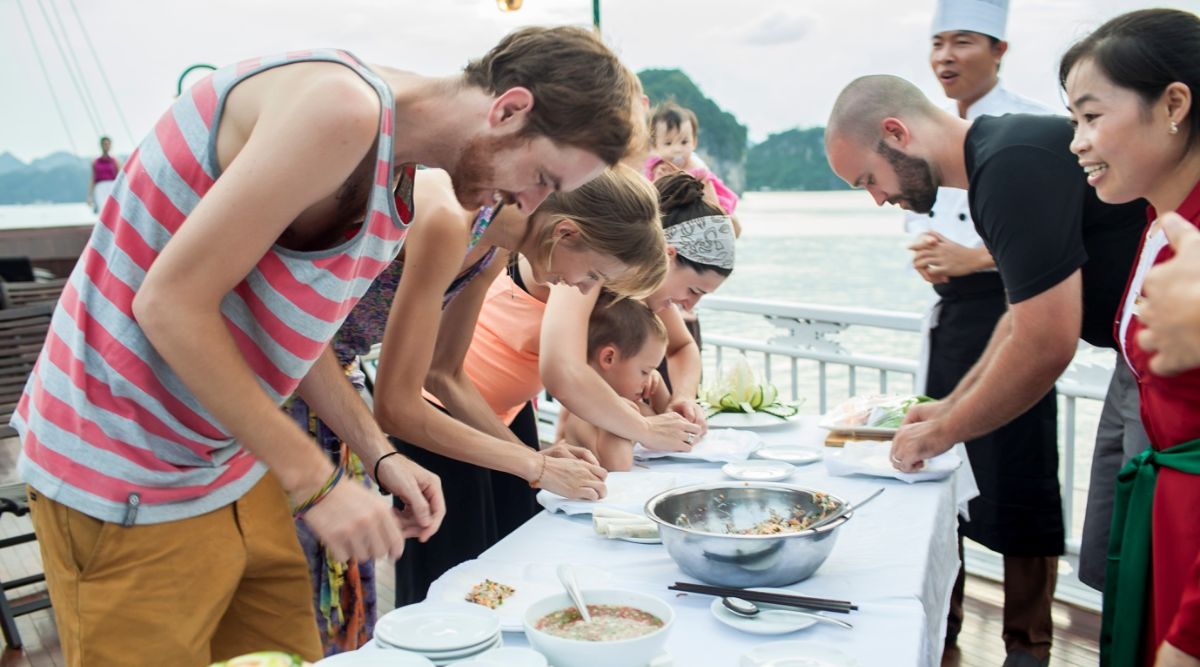
The ship is part of the experience, but onboard programmes vary much more than cruise marketing sometimes suggests. Some sailings include cooking demonstrations, evening squid fishing, morning Tai Chi or wellness facilities; others keep the programme simpler. We check the actual departure rather than assuming every ship includes the same activities.Cooking demonstration as part of an onboard cruise programme
Cave stops: check what your route actually includes
Sung Sot Cave (Surprise Cave) appears on many classic Ha Long routes, but it should be treated as a real walking stop rather than a quick photo break. There are stairs, uneven surfaces and sections where comfortable footwear matters. Luon Cave is different: some programmes use a bamboo boat or kayak through the limestone opening instead. Which one you visit depends on the cruise route and operating conditions that day.
Visiting floating villages
Vung Vieng and other former floating-community areas can appear on selected Bai Tu Long or cultural routes. The experience today is not the same as visiting a fully residential floating village, so we check the actual programme before describing it that way. Depending on the operator, the stop may focus on the landscape, local fishing heritage, rowing or nearby aquaculture activities.
Hiking and swimming at Ti Top Island
Ti Top Island combines a small beach with a steep stair climb to a viewpoint over the bay. It can be one of the more physically demanding stops on a standard Ha Long route, especially in heat or wet weather, so we treat the climb as optional rather than assuming every traveller should do it.
How to spend 1–3 days in Ha Long Bay
Choose cruise length by the wider Vietnam itinerary, not by the idea that more nights are automatically better. A day cruise keeps the trip compact but uses a large part of the day on transfers; one overnight gives the cruise itself more weight; a second night only makes sense when the wider route has enough room and the published programme adds experiences you actually want.Ha Long Bay is a Unesco world heritage site and popular travel
1 day: use Ha Long as a full-day excursion
A day cruise can work when you only have one calendar day, but the exact departure, time on the water and return to Hanoi vary by operator. Treat it as a full travel day and compare the actual sailing hours rather than assuming every “day cruise” gives the same bay time.
Pros: Cost-effective, saves time.
Cons: You miss the sunset and sunrise on the water; the route is often crowded.
2 days / 1 night: make the cruise part of the stay
For many first-time visitors, one overnight is the most balanced format because the cruise becomes part of the stay rather than a short excursion. The exact programme still depends on the ship and route.
Day 1: Most programmes board around late morning or midday, followed by lunch and one or two route-specific activities before dinner.
Day 2: Early-morning activity, breakfast or brunch, one final excursion on some routes, then disembarkation.
Why choose this? The overnight format gives you evening and early-morning time on the water, but the exact caves, islands, kayaking and onboard activities depend on the ship and route.
3 days / 2 nights: add time only when the route justifies it
If your wider Vietnam itinerary has enough room, a second cruise night can make sense because it gives the schedule more time away from the standard embarkation cycle. We would not add it automatically to a short trip.
Structure: The middle day usually gives the operator more room for a longer excursion away from the embarkation cycle, but the vessel used and the area visited differ by cruise.
Activities: Expect more time for route-specific excursions such as kayaking, swimming, caves, beaches or Cat Ba-side activities where the programme allows. Check the published itinerary rather than assuming every 3-day cruise visits the same places.
Choosing the route: Ha Long, Lan Ha or Bai Tu Long?
Ha Long, Lan Ha and Bai Tu Long share the same broad limestone landscape, but the embarkation point, cruise programme and activities can differ. When guests ask us which bay is “better,” we first look at the actual ship itinerary and transfer plan rather than choosing by the bay name alone. We normally explain the routes like this:
Ha Long Bay: The main UNESCO cruise area, with well-established routes that can include sites such as Sung Sot Cave, Luon Cave and Ti Top depending on the sailing programme.
Bai Tu Long Bay: Often chosen by travellers who prefer a route marketed around a quieter atmosphere. Cruise availability and activities vary, so compare the actual programme rather than assuming every sailing is less busy.
Lan Ha Bay: South of Ha Long beside Cat Ba, with many cruise programmes built around kayaking, lagoons and the Cat Ba side of the limestone seascape. Check the real embarkation point because transfer logistics vary by ship.
Practical checks before booking a Ha Long Bay cruise
What are the essential practical tips? Always book through a reputable operator to ensure safety, pack light with a focus on sun protection and swimwear; be aware of the “single-use plastic ban”, and understand the costs involved to avoid hidden fees. The details we check before confirming a cruise are less glamorous than the cabin photos, but they matter more when something changes:
Single-use plastic rules at the port and onboard
Ha Long Bay authorities are actively enforcing the programme to reduce single-use plastic in the heritage area. At the passenger port, follow the current instructions on items such as disposable plastic bottles, bags and cups, and check what your cruise provides before boarding rather than assuming you can carry the same items you used in Hanoi.
Compare cruise inclusions before comparing price
Cruise prices move with route, cabin type, ship age, departure date and what is included. Instead of using one fixed “budget/mid-range/luxury” number, compare the same components across operators:
Cabin and ship: Check cabin size, balcony or window, ship capacity and the actual vessel assigned to your departure.
Included programme: Compare meals, transfers, kayaking or bamboo boat fees, attraction tickets and any compulsory surcharges on the same basis.
Cancellation and weather terms: A higher cabin price is not the only risk. Read what happens if the port authority suspends sailing or the route changes.
What to pack
Sunscreen and a hat: The reflection off the water is intense.
Waterproof bag: Essential for your phone and camera when kayaking.
Light jacket: Even in summer, the breeze on the water at night can be cool.
Comfortable walking shoes: For the caves and the Titop hike.
Safety first
Before booking, check what safety equipment is carried, how the operator handles weather disruption and what happens to your payment or itinerary if sailing is suspended. Maritime conditions can change quickly, and port or local authorities may stop departures even when the weather in Hanoi looks acceptable. A clear cancellation policy matters as much as the cabin photos.
How we would fit Ha Long Bay into a Northern Vietnam route
Ha Long Bay works best when the cruise length matches the rest of the trip. If you only have five or six days in Northern Vietnam, an extra cruise night may cost you the time you wanted in Hanoi or Ninh Binh. With a longer itinerary, an overnight cruise often gives the route a better rhythm because the transfer becomes part of a two-day experience rather than a long out-and-back day.
If your route also includes Ninh Binh, we can plan the sequence to reduce unnecessary returns to Hanoi.