For most trips from Malaysia, start with the number of usable days rather than a list of attractions. With 4–5 days, one region usually gives you the cleanest trip. With 6–7 days, you can complete one region well or combine two selectively. Around 8–10 days gives you more room for two regions, while 12–14 days makes a North–Central–South journey much easier to pace.
Vietnam rewards travellers who respect its geography. Hanoi, Da Nang and Ho Chi Minh City may look easy to connect on a map, but every extra region adds another airport or long transfer, another hotel check-in and less time to experience the place you came to see.
A useful route is therefore not the itinerary with the most stops. It is the one that balances travel days, overnight bases, major transfers and the experiences that matter most to you. If you want the broader country-level planning context before choosing a route, ITG’s complete Vietnam itinerary guide is the natural parent resource for this article.
| Trip length | Recommended scope | Example structure | Typical pace |
|---|---|---|---|
| 4–5 days | One region | North, Central or South | Comfortable when focused |
| 6–7 days | One complete region or a selective two-region route | North circuit, Central circuit, or one inter-region connection | Moderate |
| 8–10 days | Two regions | North + Central or Central + South | Balanced if transfers are limited |
| 12–14 days | Two or three regions | North + Central + South | More suitable for a full-country first trip |
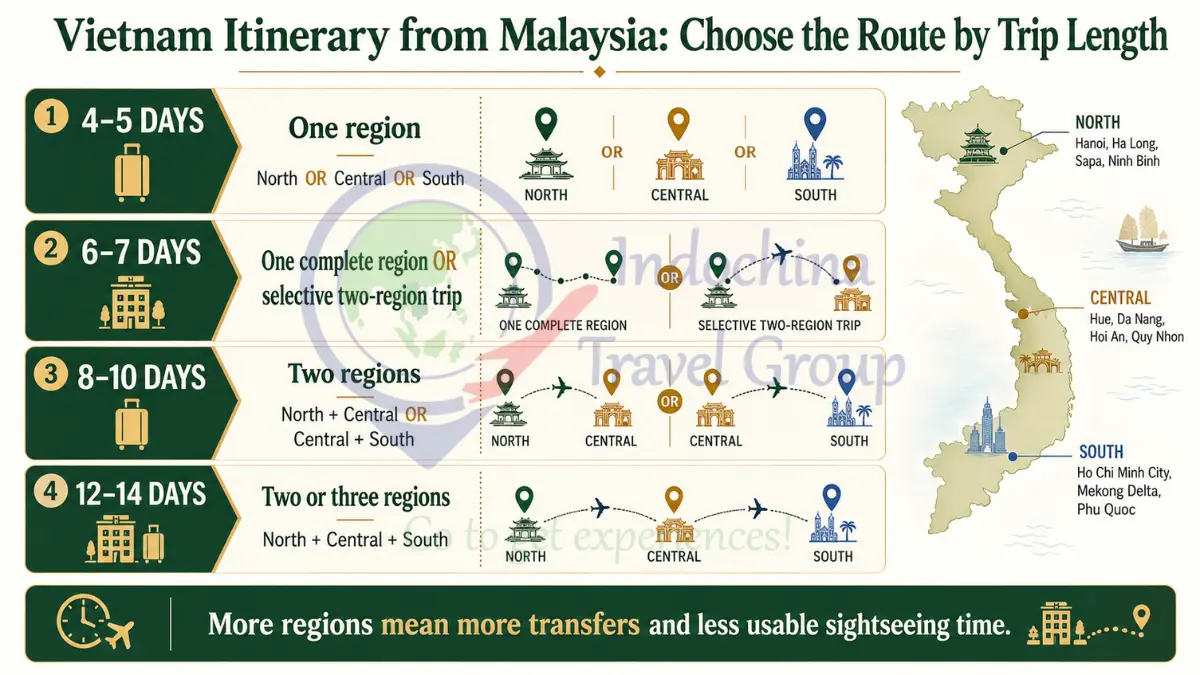
How to Plan a Vietnam Itinerary from Malaysia
Start with the time you can actually use on the ground, then choose the number of regions and major transfers that fit that window. The day-by-day plan comes after those decisions.
When we plan routes at Indochina Travel Group, the useful order is simple: days first, regions second, route third, activities fourth. This prevents a common planning mistake—starting with a long wish list and then trying to force every destination into a calendar that is too short.
For a short Vietnam trip, we would rather remove one unnecessary stop than squeeze another hotel change into the route. That usually protects more time for the places you deliberately chose.
For Malaysian travellers, this matters most on shorter holidays. A route that looks compact on a booking screen can still feel rushed once you count check-in times, road transfers, cruise embarkation, domestic transport and hotel changes.
Count Your Usable Vietnam Days Before Choosing the Route
A five-day or seven-day trip does not automatically give you five or seven full sightseeing days.
The first step is to separate calendar days from usable travel days. Your arrival day may still be useful if you land early, but it may also be little more than airport transfer, hotel check-in and a relaxed evening. Your departure day can be similarly limited. A major move between regions may consume much of another day even when the flight itself is short.
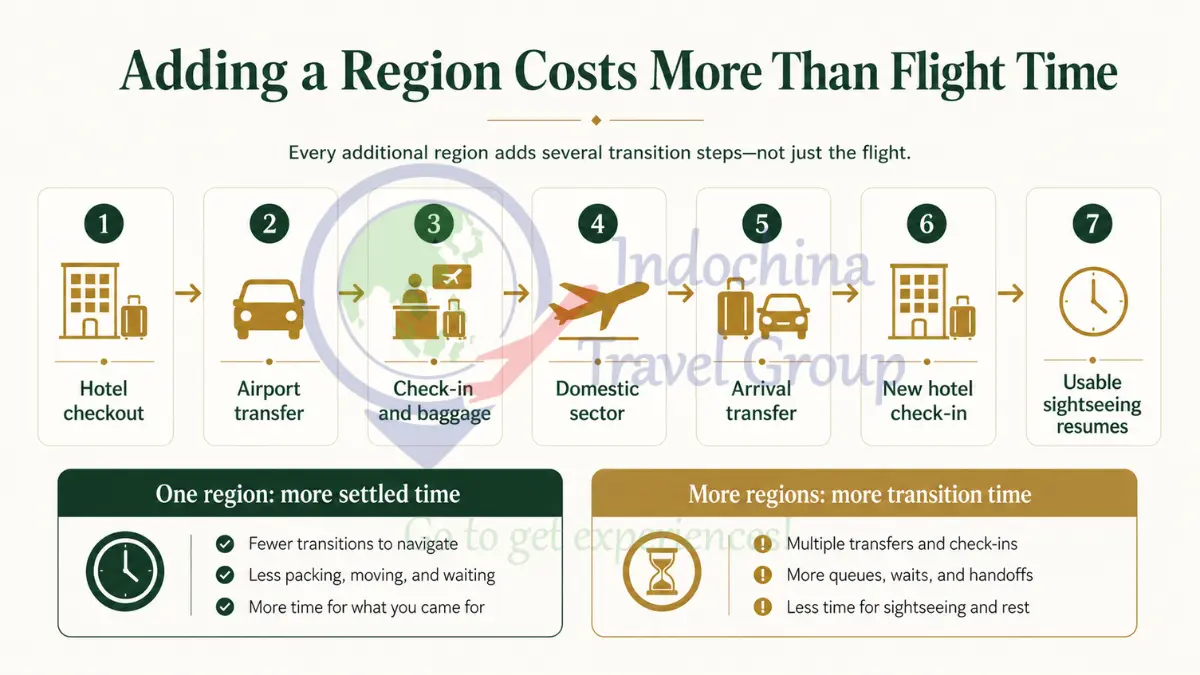
Arrival and departure days
Before assigning attractions, check when you actually reach your first hotel and when you need to leave for the airport on the final day. A late arrival should not carry a full city tour simply because the spreadsheet says “Day 1”. Likewise, an early departure should not be treated as a normal sightseeing day.
This is especially important for families, senior travellers and groups carrying more luggage. A route that allows time to settle in often works better than one that starts with an aggressive schedule immediately after arrival.
Inter-region travel days
Moving from Hanoi to Central Vietnam or from Central Vietnam to Ho Chi Minh City is not just the time spent in the air. You also need to account for hotel checkout, airport transfer, check-in, baggage, arrival transfer and the next hotel check-in.
That does not mean you should avoid domestic travel. It means each major sector should earn its place in the itinerary. If adding a second region gives you only one rushed night there, the movement may be costing more travel time than the destination gives back.
If you need to compare domestic flights, trains, private transfers and other ways to connect distant hubs, ITG’s Vietnam transportation guide goes deeper into the transport choices. This itinerary article stays focused on how those movements affect route design.
Hotel changes
Hotel changes are one of the easiest ways to underestimate itinerary fatigue. Packing, checking out, travelling, waiting for rooms and unpacking again all use attention and time. On a short trip, staying two or three nights in a well-placed base can feel much richer than changing hotels every night just to cover more map points.
Choose One Vietnam Region Before Building the Day-by-Day Plan
Once you know your usable days, choose the part of Vietnam that will anchor the trip. North, Central and South each support a complete short itinerary.
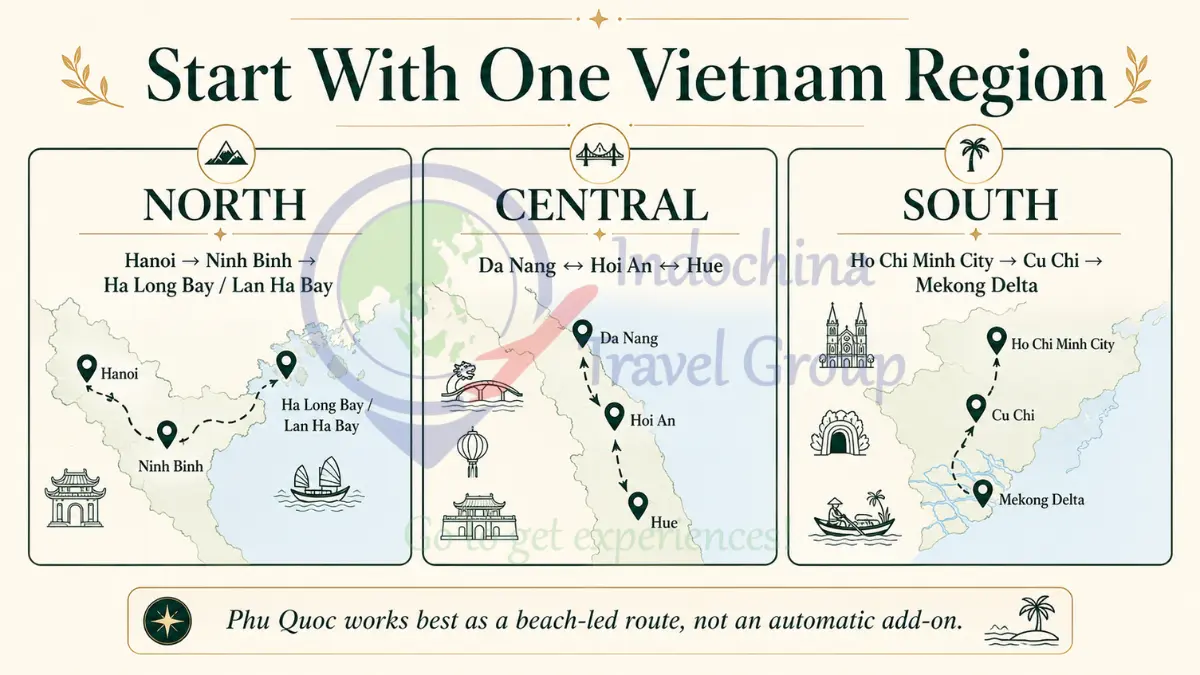
If You Choose Hanoi and North Vietnam
Hanoi is the natural base for a North-focused route. From the capital, a compact first trip can connect the limestone landscapes of Ninh Binh with Ha Long Bay or Lan Ha Bay without requiring a cross-country flight.
If the North is already your priority, ITG’s Northern Vietnam destination guide can help you decide which northern stops deserve the limited days you have.
If You Choose Da Nang and Central Vietnam
Central Vietnam is especially efficient when you want to combine heritage, food and some coastal time. Da Nang and Hoi An are close enough to be planned as one regional cluster, while Hue adds imperial history but also another road sector.
If You Choose Ho Chi Minh City and South Vietnam
Ho Chi Minh City can anchor a South-focused itinerary built around urban history, the Cu Chi Tunnels and the Mekong Delta. If the main purpose is beach time, Phu Quoc should be treated as a different route shape rather than an automatic add-on to every southern trip.
4–5 Day Vietnam Itinerary from Malaysia
For four or five days, one region is usually the cleanest way to protect sightseeing time and avoid turning the holiday into a sequence of airport transfers.
| Focus | Route framework | Best when you want | Main trade-off |
|---|---|---|---|
| North Vietnam | Hanoi → Ninh Binh → Ha Long/Lan Ha → Hanoi | Culture, karst scenery and a bay experience | Little room for Sapa or Ha Giang |
| Central Vietnam | Da Nang → Hoi An → optional Hue or Ba Na Hills → Da Nang | Heritage, food, beach and lower route complexity | Adding both Hue and several day trips can make the schedule dense |
| South Vietnam | Ho Chi Minh City → Cu Chi → Mekong Delta → Ho Chi Minh City | Urban history and river-delta culture | Not the same type of trip as a Phu Quoc beach holiday |
Example: A 5-Day North Vietnam Itinerary
- Day 1 — Hanoi arrival — Keep the first day light and use the evening for the Old Quarter or Hoan Kiem Lake if your arrival time allows.
- Day 2 — Ninh Binh — Take a focused countryside day around Trang An or Tam Coc, then return to Hanoi or stay overnight only if the next day’s cruise logistics support it.
- Day 3 — Hanoi to Ha Long Bay or Lan Ha Bay — Board an overnight cruise and let the cruise night replace a normal hotel night in your allocation.
- Day 4 — Bay to Hanoi — Return after the cruise and keep the evening flexible rather than stacking another long excursion onto the same day.
- Day 5 — Departure — Use any free time around the confirmed airport transfer instead of assuming a full sightseeing day.
The same principle applies to Central or South Vietnam: use the route table above to keep the trip regional, then fit the daily sequence around your confirmed arrival and departure times.
In a four- or five-day window, adding a distant second region changes the character of the trip. You move from a regional holiday—where evenings can still feel unhurried—to a highlights itinerary where one of your limited days is largely devoted to transition.
That may still be the right choice if seeing two specific places matters more than pace. The point is to make the trade-off deliberately rather than discover it after the tickets are booked.
6–7 Day Vietnam Itinerary from Malaysia
Six or seven days gives you two legitimate choices: complete one region with more depth, or connect two regions selectively with one major transport sector.
Complete One Region Well
A North-focused week can give Hanoi real breathing room, include Ninh Binh and allow a Ha Long Bay or Lan Ha Bay cruise without making every day a checkout day. A Central-focused week can combine Da Nang, Hoi An and Hue with time left for food, beach or a slower afternoon.
This is often the better framework for travellers who value a relaxed rhythm, are travelling with children or seniors, or simply prefer to spend more time in fewer places.
Combine Two Regions Selectively
If you prefer contrast, use one clear inter-region move rather than several. For example:
- Hanoi + Ha Long Bay + Da Nang/Hoi An: culture and limestone scenery followed by heritage and coast.
- Da Nang/Hoi An + Ho Chi Minh City: Central Vietnam heritage followed by southern city life and, if time permits, a selected Mekong or Cu Chi experience.
The second region should add something meaningfully different to the trip. If it only gives you another hotel and half a day of sightseeing, it may not be earning the transport time it requires.
Can You See North, Central and South in Seven Days?
Yes, but it becomes a fast highlights trip rather than a relaxed exploration. ITG’s current 7-day Vietnam itinerary guide treats a three-region route as a fast-paced option and also presents regional alternatives for travellers who want more depth.
8–10 Day Vietnam Itinerary from Malaysia
Eight to ten days gives you enough room to connect two regions more comfortably while still keeping the route understandable and operationally simple.
North + Central Vietnam
This route gives a first-time visitor strong contrast without requiring a full-country sprint: capital-city culture, northern landscapes, Central Vietnam heritage and a coastal change of pace.
Central + South Vietnam
Stay in One Region for a Slower Trip
Ten days does not obligate you to visit two or three regions. A deeper North Vietnam route can add Sapa after Hanoi, Ninh Binh and Ha Long Bay. A longer Central stay can combine heritage, food, beach time and countryside experiences without any domestic flight at all.
For travellers who remember places through food, conversations and unplanned afternoons rather than destination counts, this can be the richer use of the same number of days.
12–14 Day Vietnam Itinerary from Malaysia
With roughly two weeks, a first-time traveller has much more room to connect North, Central and South without making every second day a transport day.
North → Central → South
A classic full-country route can move from Hanoi and the northern landscapes to Da Nang/Hoi An, then finish in Ho Chi Minh City and the South. Instead of fixing every day first, allocate nights by region and then place the strongest experiences inside each block.
South → Central → North
There is no universal rule that a Vietnam trip must start in Hanoi. A South-to-North direction can work just as well when your entry and exit points, travel dates or preferred final experience support it.
The key is to avoid unnecessary backtracking. If your itinerary already moves along Vietnam’s north–south spine, the arrival and departure gateways should ideally follow that same direction rather than forcing you to return to the city where you started.
When to Leave Sapa or Phu Quoc for Another Trip
Sapa and Phu Quoc are both rewarding, but they sit outside the simplest Hanoi–Central Vietnam–Ho Chi Minh City spine. Adding either one creates another travel branch. Adding both can make a two-week first trip feel surprisingly fragmented.
If your main goal is a broad introduction to Vietnam, it can be better to finish the core route well and leave one detour for a second visit. If mountain trekking or island time is the main reason for travelling, reverse the logic: make that destination a priority and remove something else.
How to Keep Your Vietnam Itinerary from Becoming Too Rushed
The easiest way to spot an overloaded itinerary is to count movements, not attractions.
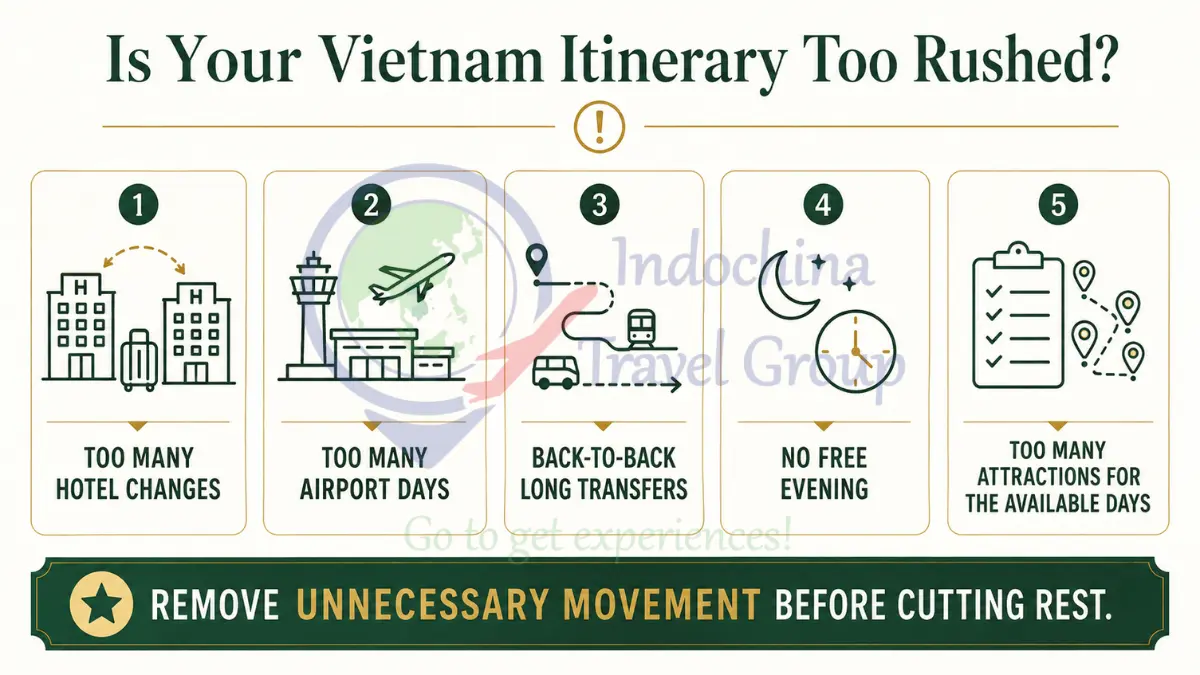
| Signal | What it usually means | What to reconsider |
|---|---|---|
| A new hotel almost every night | Too many overnight bases | Combine nearby places from one base or remove a stop |
| Several airport days in a short trip | Too many regions | Keep the regions that create the strongest contrast |
| An overnight cruise followed immediately by another major sector | Very little recovery margin | Protect transition time around the cruise |
| A long road excursion every day | High transit load | Stay closer to the chosen base on some days |
| No free evening or flexible half-day | Low resilience if weather or energy levels change | Create at least some unstructured time |
| The attraction list keeps growing while the trip length does not | A scope problem | Remove locations before compressing rest and transfer time |
- Reduce regions before reducing rest. A quieter itinerary is usually easier to enjoy than a geographically impressive one that leaves everyone exhausted.
- Count hotel changes. Every new base adds another pack–move–check-in cycle.
- Count major transfer sectors. Domestic travel is useful, but each sector needs enough destination time on the other side to justify it.
- Protect flexible time. A free evening or half-day gives the route resilience when weather, traffic or energy levels change.
- Treat arrival and departure days carefully. Build around confirmed timings rather than optimistic assumptions.
Adjust the Route for Your Travel Dates and Personal Needs
A route that looks good on paper still needs to fit the dates, people and practical requirements of the actual trip.
Weather
North, Central and South Vietnam do not share one identical weather pattern, so route selection should be checked against the season before you lock the final order of destinations. This matters most for weather-sensitive experiences such as bay cruises, beaches, mountain routes and outdoor-heavy days.
Instead of repeating a full climate guide here, use ITG’s Best Time to Visit Vietnam guide to check how the regions line up with your travel month, then return to this itinerary framework and adjust the route.
Malaysia School Holidays
If your dates are fixed by a school break, work from the fixed dates outward. Choose the Vietnam region and route that fit the travel window rather than forcing a preferred itinerary into a period that makes key experiences less reliable or more difficult to operate.
Halal and Dietary Requirements
Dietary requirements should be part of itinerary design, not an afterthought added after hotels and activities are confirmed. Restaurant choice and meal arrangements vary by destination, so tell your travel planner early if your group needs Halal-certified meals, seafood/vegetarian alternatives or other specific arrangements.
For a short trip, this can also influence which hotel area or daily sequence is most practical. The goal is not to build the whole holiday around meals, but to avoid creating a route where the confirmed dining requirement becomes difficult every evening.
A Simple Checklist Before You Finalize the Itinerary
Before you book the internal sectors or lock every hotel, run the route through these questions:
- How many nights are actually available in Vietnam?
- What time do you arrive on Day 1?
- What time do you need to leave for the airport on the final day?
- Which region is the real priority if something has to be removed?
- How many hotel bases are in the current plan?
- How many major inter-region transfer sectors are required?
- Does the route include an overnight cruise that changes the hotel-night pattern?
- Are the travel dates sensitive to regional weather?
- Does anyone in the group have dietary, mobility or pacing requirements?
- Is there at least some unstructured time?
- Is the itinerary built around meaningful experiences, or only around attraction count?
- Do the arrival and departure gateways follow the direction of the route logically?
Which Itinerary Should You Choose?
Choose the smallest route that still gives you the experiences you would genuinely regret missing.
| If you have or prefer… | Start with… |
|---|---|
| 4–5 days | One region |
| 6–7 days | One complete region or a selective two-region route |
| 8–10 days | Two regions with limited inter-region movement |
| 12–14 days | Two or three regions with clear direction |
| Very fixed dates | Check seasonal fit before finalizing the region order |
| A relaxed travel style | Fewer bases and longer stays |
| A first trip but little interest in airports | One or two regions |
| Nationwide highlights | A longer multi-region route |
A better Vietnam itinerary is often created by removing unnecessary movement, not by finding more attractions to add. Once the route is realistic, the individual experiences become much easier to choose.
Frequently Asked Questions
How many days should I spend in Vietnam from Malaysia?
Four or five days is enough for a focused regional trip. Six or seven days can cover one region well or two selectively. Eight to ten days gives more room for two regions, while roughly 12–14 days makes a three-region North–Central–South itinerary easier to pace.
Is 5 days enough for Vietnam from Malaysia?
Yes, if you focus the route. A five-day trip can work well around Hanoi, Ninh Binh and Ha Long/Lan Ha; around Da Nang, Hoi An and selected Central Vietnam experiences; or around Ho Chi Minh City, Cu Chi and the Mekong Delta. Trying to cover distant regions in the same five days adds much more transition time.
Is 7 days enough for Vietnam?
Yes, but itinerary scope matters more than the number seven itself. One region gives you more depth, two regions are practical when connected selectively, and three regions become a fast highlights trip with more time spent moving.
Can I visit Hanoi and Da Nang in one trip from Malaysia?
Yes. Hanoi and Da Nang can be combined when the trip is long enough to justify an inter-region sector. The longer your stay, the easier it is to include meaningful time in both North and Central Vietnam instead of using one city as a brief stop.
Can I visit Hanoi, Da Nang and Ho Chi Minh City in one week?
You can, but it will be a fast highlights itinerary. If you prefer more local time, fewer hotel changes and less airport movement, use the same week for one region or a selective two-region combination.
Should I start in Hanoi or Ho Chi Minh City?
Either direction can work. Choose the starting point that best fits your confirmed arrival/departure gateways, travel dates and preferred final experience. For a multi-region trip, try to move in one geographic direction rather than backtracking unnecessarily.
Is Da Nang a good base for a short Vietnam trip from Malaysia?
Yes. Da Nang can work well as part of a Central Vietnam itinerary because it connects naturally with Hoi An and can also support a Hue or selected day-trip extension when the schedule allows. You do not need to change hotels for every nearby destination.
Should I book domestic flights before finalizing my Vietnam itinerary?
Build the route structure first, then verify current transport schedules before confirming the day-by-day plan. Transport availability and timings can change, so the itinerary should be adjusted around the confirmed sectors rather than assuming an ideal connection will always be available.