

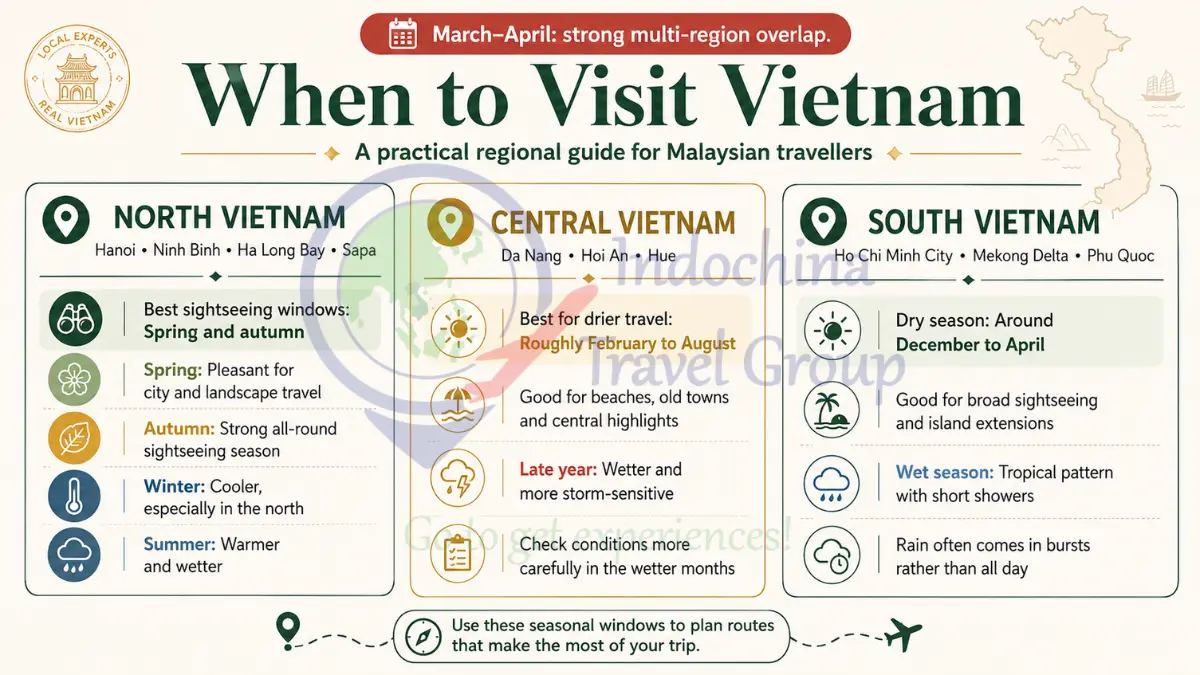
For Malaysian travellers planning a first Vietnam trip, March and April are among the easiest months to start with when you want more than one region. North Vietnam is moving into milder spring conditions, Central Vietnam is generally in a sunnier part of its year, and South Vietnam is still within its drier season. But the best month changes as soon as the route changes.
A Hanoi–Ninh Binh–Ha Long trip, a Da Nang–Hoi An–Hue holiday and a Ho Chi Minh City–Mekong Delta–Phu Quoc journey do not share one weather calendar. The most useful way to plan from Malaysia is therefore to match your available month → the Vietnam region → the route you can comfortably cover.
| Trip focus | Best starting window | Why it works | Watch for |
|---|---|---|---|
| First multi-region Vietnam trip | March–April | One of the easiest overlaps between North, Central and South | North can still feel cool early in March |
| Hanoi, Ninh Binh, Ha Long Bay or Sapa | Spring or autumn | Milder sightseeing conditions than peak summer | Winter can be cool or misty; summer is hotter and wetter |
| Da Nang, Hoi An and Hue | March–August | Strong fit for coast, heritage and a compact regional route | Heat rises in summer; late-year rain needs flexibility |
| Ho Chi Minh City, Mekong Delta and Phu Quoc | December–April | Southern dry-season pattern is easier for city, river and island plans | Phu Quoc becomes much more weather-sensitive in July–September |
When Is the Best Time to Visit Vietnam from Malaysia?
For a broad first trip, March and April are the most practical starting point. For a focused regional trip, the answer can be very different.
Vietnam Tourism describes March to May as one of the strongest countrywide weather periods, but a Malaysian traveller does not need the whole country to have the same conditions. If your holiday is only five or six days, choosing the right region matters more than finding a theoretical “perfect month” for Vietnam as a whole.
A March trip can work across several route shapes. By June, Central Vietnam usually has the clearest weather-led advantage for a short holiday. By October, North Vietnam becomes more attractive while Central Vietnam is more rain-sensitive. In December, South Vietnam becomes one of the simplest choices, while the North works well for travellers who are comfortable with cooler weather.
Do not choose seven attractions across Vietnam and then ask whether the weather fits. Fixed dates should narrow the map before the itinerary expands.
Why Vietnam’s Weather Needs a Different Planning Mindset from Malaysia
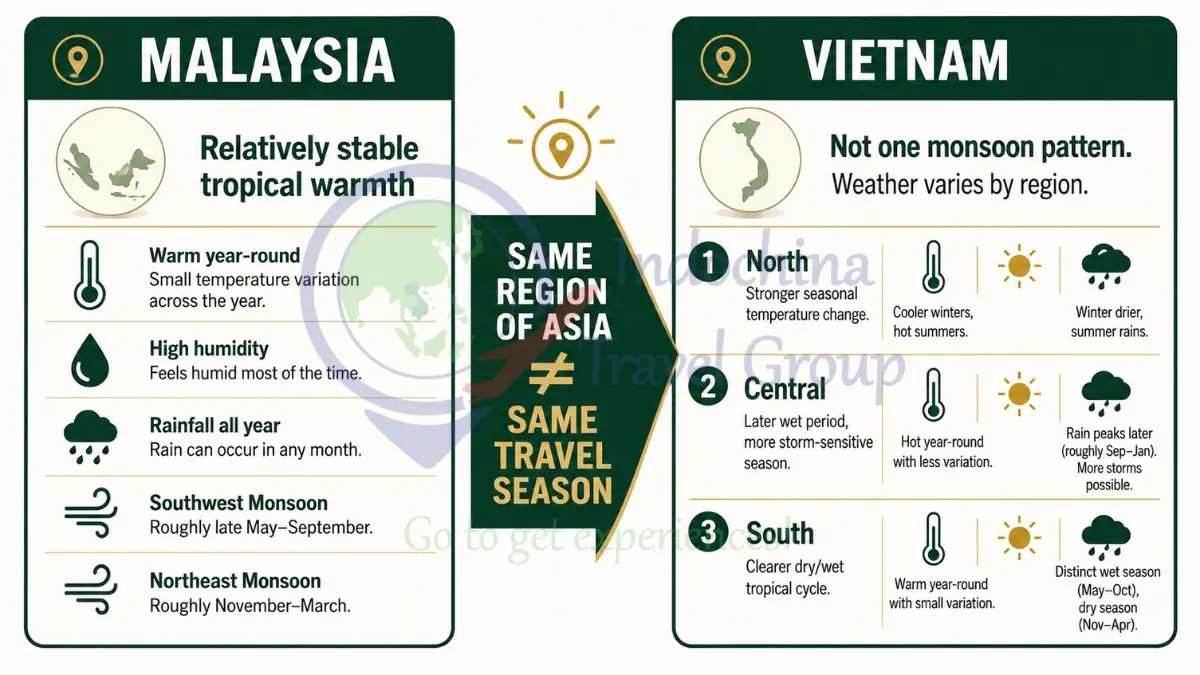
Malaysia and Vietnam are both in Southeast Asia, but Malaysia’s monsoon labels are not a shortcut for predicting a Vietnam holiday.
Malaysia is warm and humid through the year. METMalaysia describes two main monsoon regimes: the Southwest Monsoon from roughly late May to September and the Northeast Monsoon from November to March, with local rainfall effects varying by state and coast.
Vietnam’s long north-to-south geography creates a different pattern. Hanoi can be cool while Ho Chi Minh City is hot. Hoi An can be entering its wetter late-year period while the North is moving into clearer autumn conditions. Phu Quoc can be storm-sensitive at the same time that Central Vietnam still has workable summer weather.
Warm year-round, with rainfall patterns changing by monsoon and location.
North, Central and South can require different travel decisions in the same week.
Best Time for North, Central and South Vietnam from Malaysia
For a short-haul trip from Malaysia, the most useful weather question is often not “What is Vietnam like this month?” but “Which part of Vietnam gives me the best route for the days I have?”
Hanoi, Ninh Binh, Ha Long Bay and Sapa
Spring and autumn are the easiest starting points for sightseeing. Hanoi and Ha Long Bay generally become warmer from April, while September to November brings a clearer, cooler autumn pattern in much of the North.
- Good fit: culture, city walking, limestone landscapes and mountain extensions.
- Winter: cooler, sometimes misty; Sapa can feel genuinely cold.
- Summer: hotter, more humid and wetter, with storms sometimes affecting cruises or road plans.
Da Nang, Hoi An and Hue
March through August gives the clearest planning window for a combined coast-and-heritage trip. Vietnam Tourism places Hoi An’s warmer, sunnier period from February to August and Hue’s from March to August.
- Good fit: Da Nang beach time, Hoi An evenings, heritage and a compact regional route.
- May–August: strong seasonal fit, but daytime heat becomes more important.
- September onward: rain, storms and flooding risk increase, especially for outdoor and coastal plans.
Ho Chi Minh City, Mekong Delta and Phu Quoc
December to April is the simplest all-round window for this southern route. Ho Chi Minh City and the Mekong Delta are hot throughout the year, while the drier months make a city-and-island combination easier to plan.
- Good fit: city, food, Mekong experiences and island extensions.
- May–November: city travel remains possible with tropical showers and flexible timing.
- July–September: Phu Quoc is significantly more weather-sensitive because of stormier sea conditions.
If two or three regions still fit your travel month and the harder question is where to spend the trip, compare which part of Vietnam best fits your trip from Malaysia before choosing individual attractions.
Vietnam Weather by Month: What It Means for Your Route from Malaysia
Use this table as a route filter, not a promise of daily weather. It shows which region is usually easiest to build around in each month and where flexibility matters more.
| Month | North | Central | South | Best planning use |
|---|---|---|---|---|
| January | Cool / mist possible | Some late wet-season effect | Dry-season strength | South-led trip; North if cooler weather suits you |
| February | Cool | Improving | Strong | Central or South; pack layers for the North |
| March | Milder | Strong | Strong | One of the easiest multi-region months |
| April | Strong | Strong | Hot / mostly dry | Excellent for a broad first trip |
| May | Hotter / wetter trend | Strong | Wetter season begins | Central Vietnam becomes the clearest weather-led choice |
| June | Hot / humid / rainy | Strong but hot | Regular showers | Central-focused holiday rather than a weather-led nationwide route |
| July | Wet / storm-sensitive | Still workable | Wet; Phu Quoc sensitive | Central Vietnam, with heat-aware pacing |
| August | Hot / wet | Workable, transition ahead | Wet; island caution | Focused route; avoid depending on perfect beach conditions |
| September | Improving | Rain / storm-sensitive | Wet | North becomes more attractive; Central requires flexibility |
| October | Strong | Wet / storm-sensitive | Improving | North-led trip; South increasingly useful |
| November | Strong / cooler | Still wet in key areas | Improving toward dry season | North or South rather than a Central-led route |
| December | Cool / drier | Late wet-period effect | Strong | South Vietnam; North for a cooler cultural trip |
Choose the Travel Month Around the Route You Actually Want
Weather becomes much easier to use once the route is specific. The same June date can be a reasonable choice for Da Nang and Hoi An but a less obvious choice for a three-region itinerary. The same December date can be excellent for Ho Chi Minh City and Phu Quoc but less straightforward for a Central Vietnam beach holiday.
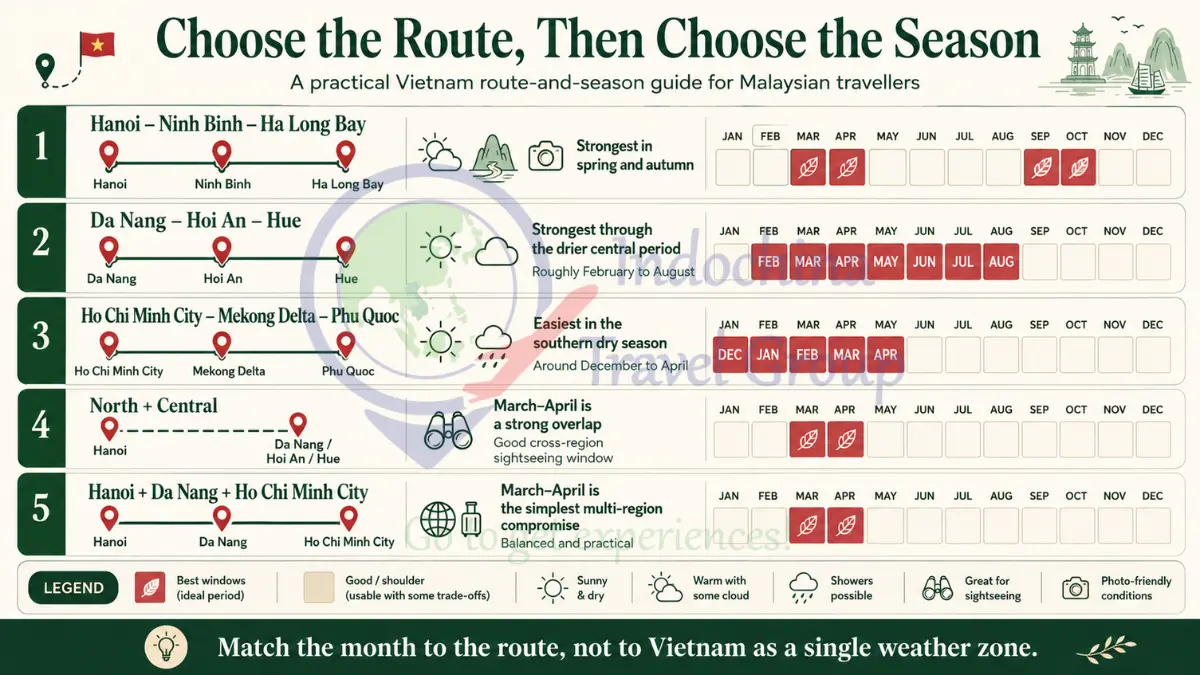
Once you know the region, the next question is how much can fit without turning the holiday into a sequence of transfers. Choose a Vietnam itinerary by trip length before adding more cities.
What If Your Vietnam Dates Are Fixed by Malaysia School Holidays?
Do not force the same Vietnam route into every school break. When the dates cannot move, let the season decide which region should move up or down your shortlist.
A mid-year break can make Central Vietnam a clearer starting point. A year-end break naturally strengthens South Vietnam, while North Vietnam remains attractive for families who prefer cooler weather and cultural sightseeing. The late-August to early-September period requires more flexibility because several regions are weather-sensitive in different ways.
The school calendar also changes the planning problem: an official break is not the same as the number of usable days you will have in Vietnam after flights, airport time and family pacing are considered.
If school dates are the constraint driving the trip, plan Vietnam around Malaysia school holidays using the dedicated date-to-region guide rather than expanding this weather article into a second school-calendar page.
When Weather Requires More Flexibility
A weather-sensitive month does not automatically make Vietnam a bad choice. It changes how much of your itinerary should depend on one outdoor condition.
North Vietnam in summer
Heat, humidity and heavier rain can make long outdoor days more tiring. Ha Long Bay cruises and mountain routes also need more room for operational or weather changes.
Central Vietnam late in the year
Rain, storms and occasional flooding can affect road transfers, beaches and outdoor sightseeing. A rigid coast-heavy plan carries more risk than a route with alternatives.
South Vietnam in the wet season
City travel can remain practical because showers may be intermittent. The bigger concern is when the trip depends heavily on island, sea or boat conditions.
Your Arrival City Can Change How Many Good Days You Actually Have
Once the month and region are chosen, flight timing becomes part of the weather decision. A late arrival followed by a long road transfer can turn a five-day holiday into only three strong sightseeing days. Flying into the region you actually plan to explore usually protects more usable time than choosing a gateway first and adding domestic movement later.
For example, a Central Vietnam trip should be built around the gateway and flight timing that support Da Nang, Hoi An and Hue efficiently. A South Vietnam trip that includes Phu Quoc needs enough margin for the island sector rather than assuming every calendar day is available for sightseeing.
After you choose the region, check flight options from Malaysia to Vietnam before locking the first and last night of the itinerary.
A Simple Way to Choose Your Vietnam Travel Month
- Start with the dates you can actually travel. Do not search for a perfect nationwide month if your leave is already fixed.
- Use weather to narrow Vietnam to one or two regions. The country does not need to be equally good everywhere.
- Choose the route that fits your usable days. A short holiday usually benefits from fewer hotel changes and fewer major transfers.
- Identify the weather-sensitive highlight. Cruise, beach, mountain road or island time should influence how much flexibility you keep.
- Recheck the forecast close to departure. Seasonal guidance helps you choose the route; a current forecast helps you sequence the final days.
For many first-time Malaysian travellers, March and April remain the easiest all-round starting point. But a good Vietnam trip does not require nationwide perfect weather. A focused Central Vietnam holiday in June or a South Vietnam trip in December can be a better decision when the region, route and number of days align.
Frequently Asked Questions
What is the best month to visit Vietnam from Malaysia?
March and April are among the easiest all-round months for a first multi-region trip. If you are visiting only one region, other months can be just as useful: Central Vietnam has a strong spring-to-summer window, while South Vietnam is especially straightforward from December to April.
Is June a good time for Malaysians to visit Vietnam?
Yes, especially for a Central Vietnam route around Da Nang, Hoi An and possibly Hue. North Vietnam is hotter and wetter by June, while South Vietnam is already within its wetter season, so June is less naturally balanced for a full-country itinerary.
Is December a good time to visit Vietnam from Malaysia?
December is a strong starting point for South Vietnam, including Ho Chi Minh City, the Mekong Delta and Phu Quoc. North Vietnam is cooler and can still suit culture-focused travel. Central Vietnam is more rain-sensitive late in the year.
Is Vietnam colder than Malaysia?
Parts of Vietnam can be much cooler than Malaysia, especially North Vietnam in winter and mountain areas such as Sapa. South Vietnam remains tropical and will feel more familiar to Malaysian travellers.
Should I avoid Vietnam during the rainy season?
No. The impact depends on the region and activity. City sightseeing can often adapt to short showers, while cruises, beaches, mountain roads, ferries and boat activities are more sensitive to severe weather or rough conditions.

Recommended Tours

Private Tour
Vietnam Premium Discovery In 21D20N
Hanoi - Ha Giang (The Far North) - Pu Luong - Ninh Binh - Halong Bay - Phong Nha Caves - Hue - Ba Na Hills - Hoi An - Ho Chi Minh City - Mekong Delta





4D3N HIGHLIGHT OF MIDDLE OF VIETNAM (SEAT IN COACH)


Private Tour
Hanoi - Ninh Binh (Hoa Lu - Tam Coc) - Halong Bay - Hanoi
Group Tour
Da Nang, Hoi An & Phu Quoc 6 Days 5 Nights Tour
Da Nang Arrival - Coconut Basket Village - Hoi An Ancient Town - Ba Na Hills - Golden Bridge - Fly to Phu Quoc - Grand World - Sun World Hon Thom - Kiss Bridge - Vinpearl Safari - VinWonders - Phu Quoc Departure