

The useful flight decision is not simply which fare is cheapest. It is where you want the Vietnam route to begin, what time the flight arrives, whether a connection is needed and how much usable holiday time remains after immigration and the hotel transfer. This guide compares the main gateways and route shapes for travellers flying from Australia.
Choose the Vietnam Gateway Before You Compare Fares
For an Australia-to-Vietnam trip, the arrival airport changes the itinerary more than the headline fare does. Hanoi, Ho Chi Minh City and Da Nang open different route shapes, so compare the schedule for your dates and choose the gateway that reduces unnecessary domestic travel after arrival.Choose the arrival city from the first region you actually want to explore. This guide compares Hanoi, Ho Chi Minh City and Da Nang as itinerary gateways rather than treating one airport as universally better.
If the trip ends in a different part of Vietnam from where it begins, compare an open-jaw ticket with a return to the same city. The useful comparison is total journey time plus any domestic sector you would otherwise need.Three Gateways Create Three Different Route Shapes
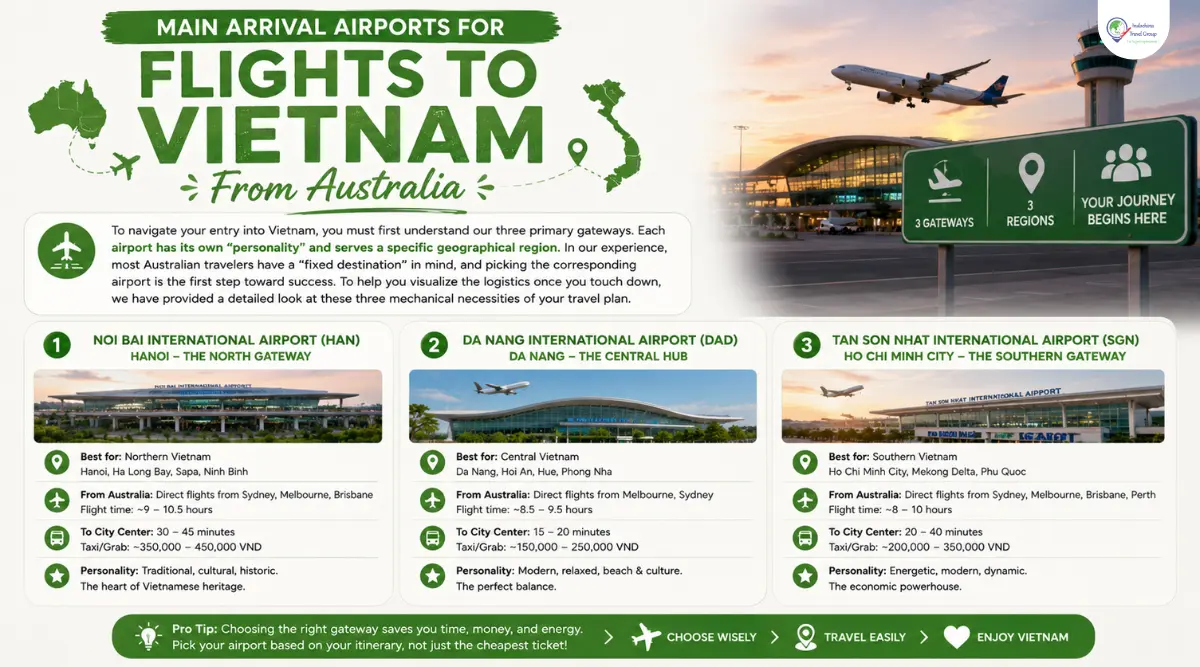 For itinerary planning, the useful arrival gateways are Hanoi (HAN), Ho Chi Minh City (SGN) and Da Nang (DAD). The right airport depends on the first region of the trip, the airline schedule available from Australia and whether an open-jaw itinerary can remove an unnecessary domestic flight.
Tan Son Nhat International Airport (SGN), Ho Chi Minh City
SGN is the main gateway for itineraries beginning in Ho Chi Minh City and Southern Vietnam. It works well when the route continues to the Mekong Delta, Phu Quoc or other southern stops.- Useful for: Southern-focused itineraries, Ho Chi Minh City, Mekong Delta and onward island connections.
- Transfer note: The airport is within the urban area, but road time to the hotel can vary substantially with traffic and the exact district. Build the first activity around the confirmed arrival and transfer time.
Noi Bai International Airport (HAN), Hanoi
HAN is the main gateway for Northern Vietnam. Use it when Hanoi, Ninh Binh, Ha Long Bay, Sapa or Ha Giang form the first part of the route.- Useful for: Hanoi-based routes, Northern Vietnam road trips and Ha Long or Lan Ha Bay cruise connections.
- Transfer note: Airport-to-city time changes with traffic and hotel location, so protect enough buffer before fixed train, cruise or tour departures.
Da Nang International Airport (DAD), Da Nang
DAD is the practical gateway for Da Nang, Hoi An and much of the Central Vietnam core. It can reduce backtracking when the trip is centred on the coast and heritage cities rather than Hanoi or Ho Chi Minh City.- Useful for: Da Nang, Hoi An and Central Vietnam itineraries where the coast or heritage core is the main focus.
- Transfer note: The airport is close to central Da Nang, while Hoi An and Hue require onward road travel. Use the actual hotel and flight time rather than a fixed transfer estimate.
Use a Nonstop Flight When It Protects Usable Holiday Time
For a trip with limited usable days, the main advantage of a nonstop flight is not prestige but simplicity. Removing a connection can reduce missed-connection risk, baggage handoffs and the amount of the first day lost before you reach the hotel.Nonstop Australia–Vietnam services operate on selected routes, but city pairs, airlines and frequencies can change by season and travel date. Confirm the current airline timetable for your exact dates before you build the first or final sightseeing day around a specific flight.
The useful comparison is total travel time, arrival hour and the city where you want to begin—not simply the cheapest fare. A slightly more expensive nonstop service can be better value if it avoids an overnight connection or an immediate domestic flight after arrival.Compare Gateways by What Comes Next
For itinerary planning, compare arrival gateways by what they unlock next. Exact flight times and frequencies change, so use the table below as a route-planning framework rather than a fixed timetable:| Arrival gateway | Best itinerary use | Planning note |
| Ho Chi Minh City (SGN) | Southern Vietnam or south-to-north routes | Useful for Ho Chi Minh City, Mekong Delta and onward travel north. |
| Hanoi (HAN) | Northern Vietnam or north-to-south routes | Best when Hanoi, Ninh Binh, Halong Bay or Sapa are early priorities. |
| Da Nang (DAD) | Central Vietnam | Convenient for Da Nang, Hoi An and Hue, often via a domestic or regional connection. |
A Connection Can Still Be the Better Route
Direct flights are convenient, but a one-stop itinerary can still make sense when it improves the departure time, arrival city, fare or loyalty options. Compare the whole journey rather than assuming nonstop is automatically better for every route.For a one-stop ticket, check whether baggage is through-checked, whether the connection is on one ticket, and how much buffer the layover leaves if the first sector is delayed. Those details can matter more than the advertised fare difference.
One-stop routes can also open arrival options that are not available nonstop from the departure city. If Da Nang or another non-Hanoi/non-Ho-Chi-Minh gateway fits the land route better, compare whether one international connection is preferable to arriving elsewhere and adding a domestic flight.Let the First Region Choose the Airport
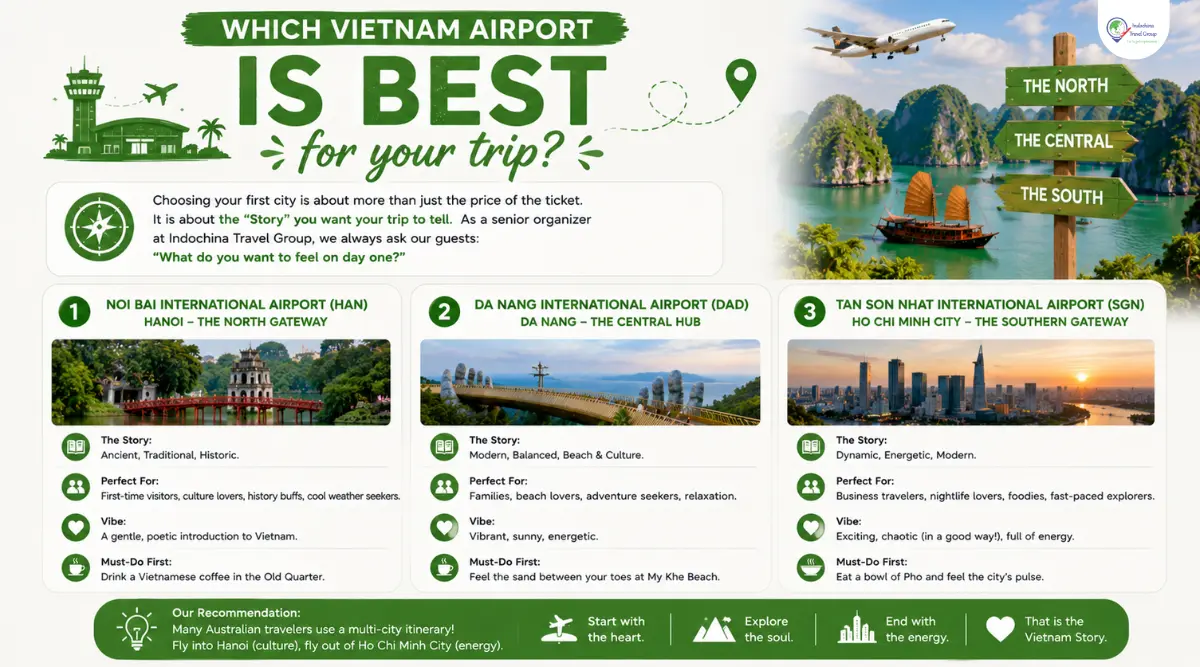 Choose the first city by the route that follows. The useful questions are which region comes first, whether you can avoid a domestic backtrack, and what the arrival time leaves realistically usable on day one.
Ho Chi Minh City first
Start in Ho Chi Minh City when Southern Vietnam, the Mekong Delta or Phu Quoc comes first in the itinerary. It is also useful for south-to-north routes when the departure flight is easier from Hanoi.Hanoi first
Start in Hanoi when the first section is Hanoi, Ninh Binh, Ha Long Bay or a northern mountain extension. This can remove an unnecessary domestic flight before the main sightseeing begins.Da Nang first
Start in Da Nang when the Central Vietnam core is the main focus and the available flight connection works. This can reduce backtracking between Da Nang, Hoi An and Hue.Compare Door-to-Hotel Time, Not Flight Time Alone
The useful number is the total journey from your Australian departure point to the first hotel or destination in Vietnam. Add airport check-in, any connection, immigration and baggage, the airport transfer and any domestic sector required after arrival.A shorter international sector can still create a longer holiday journey if it lands in the wrong region or requires another flight immediately after arrival. Compare how much usable time remains once you actually reach the place you came to visit.
The time difference between Australia and Vietnam varies by state and daylight-saving period. More importantly for the itinerary, a late-night arrival or early onward connection can reduce the first usable touring day. Build the route around the confirmed arrival time rather than assuming sightseeing starts as soon as the aircraft lands.How to choose the flight route for your itinerary
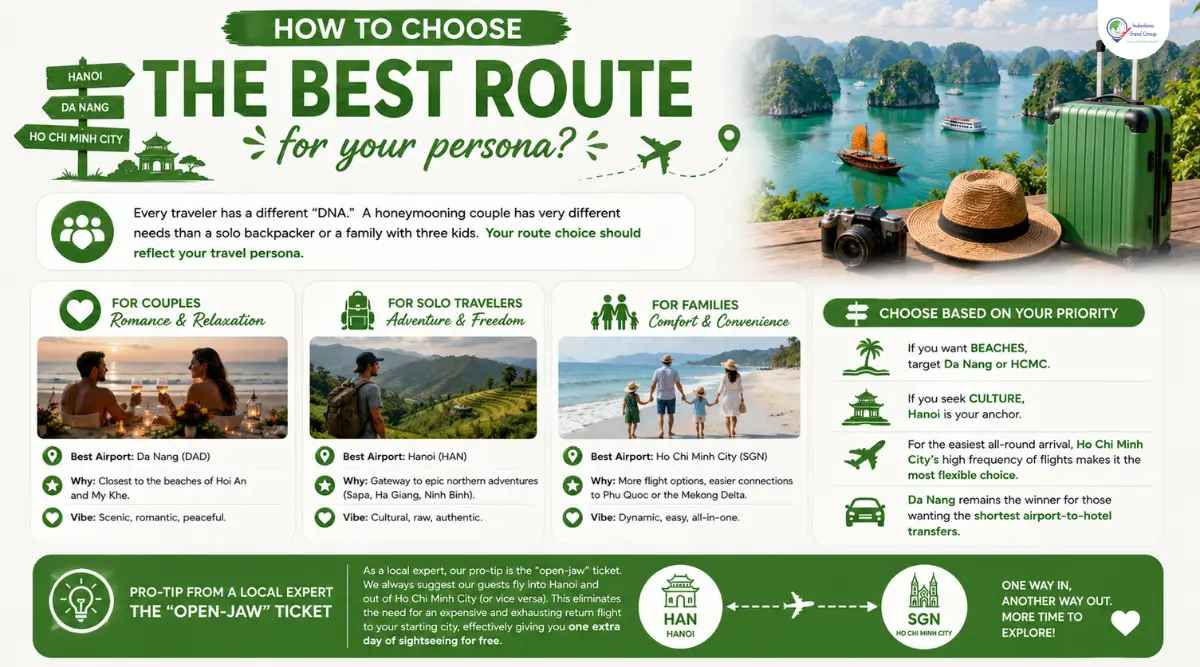 The flight route should follow the land itinerary, group needs and usable holiday time. A family, couple or solo traveller may make different trade-offs, but the same questions apply: arrival hour, connection risk, baggage, airport transfer and whether the ticket creates backtracking.
Use Hanoi when Northern Vietnam comes first, Da Nang when the Central core is the main focus, and Ho Chi Minh City when the route begins in the south. Then compare the actual flight schedule and total door-to-hotel time for your travel date.
For a one-way North-to-South or South-to-North itinerary, compare an open-jaw ticket with a return ticket to the same city. It can reduce backtracking, but the benefit depends on airfare, schedules, baggage rules and the domestic transport you would otherwise need.Before You Book, Check the Ticket Against the Itinerary
Before booking, compare the ticket as part of the whole itinerary rather than as a standalone fare. Arrival time, checked baggage, connection length and the first hotel transfer can change the practical value of two otherwise similar options. If your dates fall around school holidays or another fixed travel window, use our when to book a Vietnam holiday from Australia guide for the timing decision.Compare baggage allowances and connection rules before paying, and verify that the arrival airport fits both the visa details and the land route. During Australian school holidays, Tet and other high-demand periods, check fares earlier than usual rather than relying on one fixed booking window.
For low-cost fares, compare the final price after baggage, seat and other optional charges rather than the headline fare alone. Around Tet or other high-demand dates, availability and prices can change quickly, so confirm the current fare and conditions before the itinerary is locked.Turn the Flight Choice Into a Route
Once you know the arrival and departure airports, the next question is how many regions fit between them without unnecessary backtracking. Use our Vietnam itinerary from Australia guide to compare a practical 10–14 day route, or continue with the Vietnam transportation guide if the question is how to move around after you land.Choose the Gateway That Protects Your Holiday Time
Your arrival airport is a routing decision, not just a flight-booking detail. Pick the gateway that reduces backtracking, then confirm the arrival time before fixing the first sightseeing day.We can plan the land route around the flights you actually book. Compare route options on our Vietnam Tour Packages From Australia page.

Recommended Tours

4 Days 3 Nights from


5 Days 4 Nights from


Group Tour
Hanoi – Sapa – DaNang 8 Days 7 Nights
HotelCruiseFlightsTour
Hanoi - City Tour - Sapa- Cat Cat Village - Moana Cafe - Fansipan - Muong Hoa Train - Ninh Binh - Tam Coc - Halong Bay - Da Nang - Hoi An Ancient Town - Bana Hills - Golden Bridge
8 Days 7 Nights from


Group Tour
Vietnam – Joining Group Tour 12 Days
HotelCruiseFlightsTour
Ha Noi City Tour - Ninh Binh - Halong Bay Overnight On Cruise - Hue - Hoi An Eco Tour - Ho Chi Minh City - Cu Chi Tunnels - Mekong Delta
12 Days 11 Nights from


5D4N DISCOVER HANOI – HALONG (DAY CRUISE) – TAM COC (SEAT IN COACH)
HotelCruiseFlightsTour
from


Group Tour
Hanoi – Ho Chi Minh – Siem Reap 8D7N
HotelCruiseFlightsTour
Hanoi - Ninh Binh - Halong Bay Overnight On Cruise - Ho Chi Minh - Cu Chi Tunnels - Siem Reap - Angkor Wat Full Day
8 Days 7 Nights from