
How does money work in Vietnam?
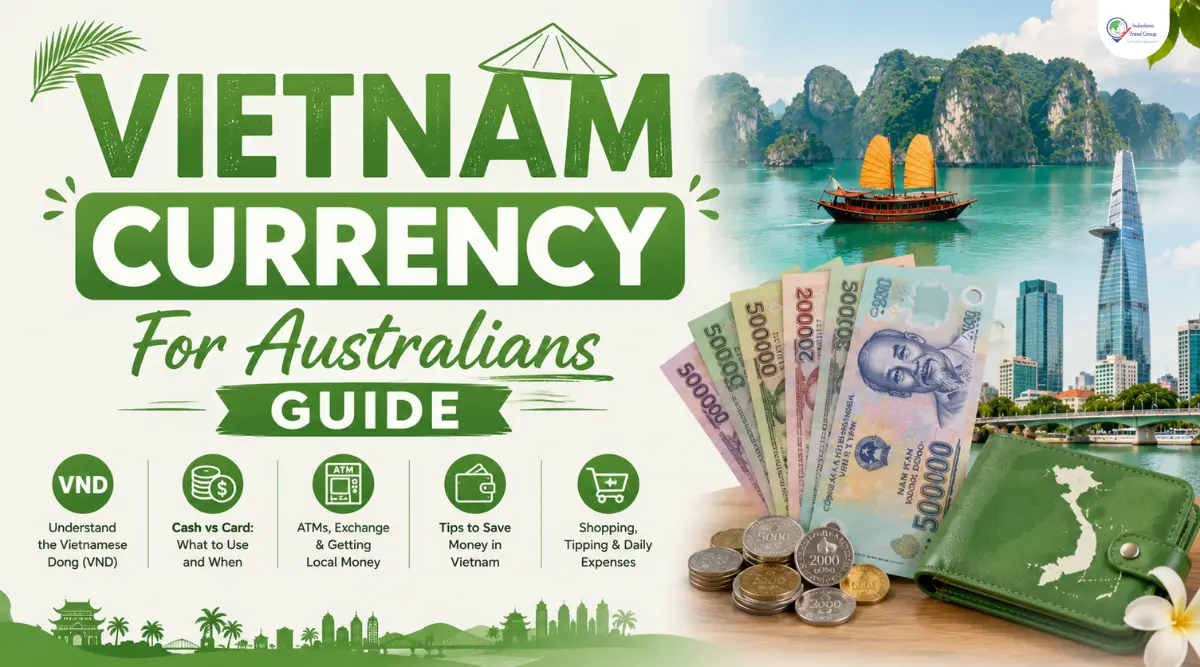
Vietnam uses the Vietnamese đồng (VND), and the number of zeros on common banknotes can take a little time to read confidently. The practical goal is to recognise the main note values, keep smaller notes available for everyday purchases and check the current AUD–VND rate before exchanging or withdrawing cash.Before Converting AUD to VND: Know the Notes You Will Use
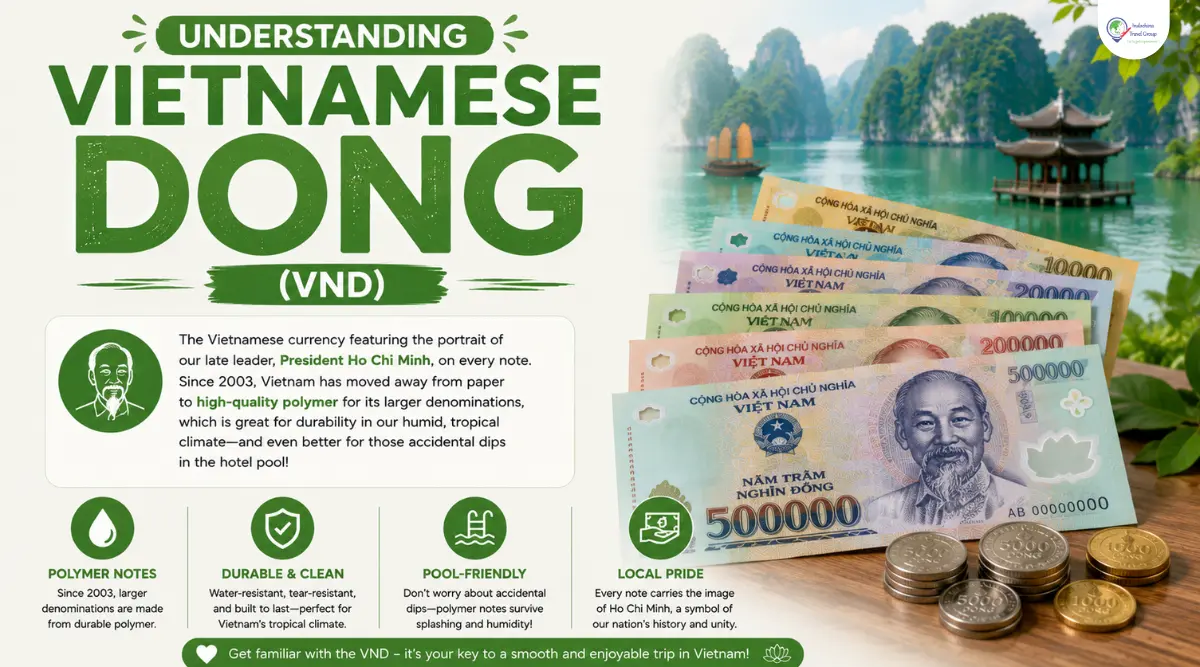 Vietnamese banknotes are denominated in VND, and the larger denominations commonly used by travellers are polymer. Several notes can look similar at a quick glance, so read the printed denomination and number of zeros rather than relying on colour alone. For a broader denomination overview, see our Vietnam currency guide.
Coins Are Rare in Everyday Use
Visitors will usually handle banknotes rather than coins. Keep some smaller VND notes available for low-value purchases, and do not assume a small vendor can easily break a 500,000 VND note.Read the thousands first
For quick mental checking, separate the thousands in a VND price first, then use the current AUD–VND reference rate from your bank or a reliable currency source. Do not memorise one conversion because the exchange rate changes over time.Common Note Values to Recognise
The useful habit is to check the printed denomination rather than memorising colours. Common notes you may handle include 500,000, 200,000, 100,000, 50,000, 20,000 and 10,000 VND.- 500,000 VND: The highest-value banknote commonly used by travellers; keep it separate from smaller everyday notes if that helps avoid mistakes.
- 200,000 and 100,000 VND: Useful for larger everyday purchases where cash is accepted.
- 50,000, 20,000 and 10,000 VND: More convenient for smaller purchases and change.
AUD to VND basics: Exchange rate awareness
Planning your conversion
When comparing payment options, check your own bank or card for foreign-transaction fees, ATM fees and currency-conversion rules. A card that works well for one traveller may not be the cheapest for another, so compare the total fee structure before departure rather than relying on one named provider.What affects the rate on the ground?
Cash-exchange rates differ by provider, location, note condition and commission. Use a licensed or reputable exchange provider, check which AUD denominations it accepts, and compare the final VND amount before handing over cash.Where to exchange money: compare the final amount
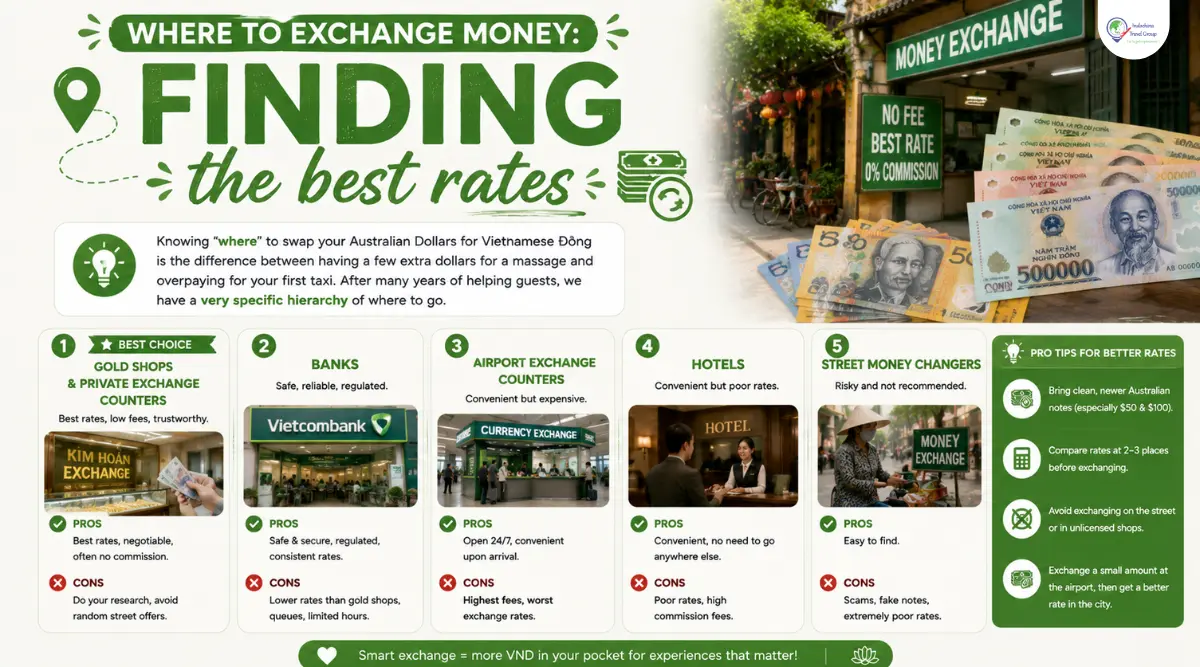 Exchange rates and fees vary by provider, location and day. Compare the rate, commission and final VND amount before completing the transaction, and use licensed or reputable providers rather than relying on one permanent “best” exchange location.
Before you leave Australia
Some travellers prefer to arrive with a small amount of VND, while others withdraw or exchange after arrival. Either approach can work; compare the fee and rate offered by your bank, card or exchange provider before deciding.On Arrival at the Airport
Major international airports may offer ATMs and currency-exchange counters, but opening hours, available services and rates can change. Use airport exchange for convenience when needed rather than assuming it is automatically the best-value option.- Useful for: Getting a modest amount of VND for immediate expenses after arrival.
- What to check: The displayed rate, commission, ATM fee and the final VND amount before confirming.
Banks and official exchangers
Banks and licensed exchange providers are useful when you want a formal counter transaction. Identification requirements, opening hours, exchange rates and processing time vary, so check the branch or provider before making a special trip.Licensed jewellery or gold-shop exchange counters
Some jewellery or gold shops offer licensed foreign-exchange services, but not every shop is authorised and the rate varies. If you use one, confirm that it is legally permitted to exchange currency and compare the quoted amount before handing over cash.Using ATMs in Vietnam
ATMs can be a practical way to access VND without carrying large amounts of cash from Australia. Availability is generally better in cities and major visitor areas than in remote locations, while withdrawal limits, local fees and your home-bank charges vary by machine and card. Australia’s Smartraveller guidance for Vietnam also recommends checking with your bank that your card will work before departure; treat that issuer check as part of the payment plan rather than assuming an Australian card will work everywhere.Withdrawal limits and fees
Withdrawal limits and fees vary by bank, ATM and card. Check the amount shown by the machine before confirming, and compare your home-bank fee, local ATM fee and any currency-conversion charge rather than relying on a fixed withdrawal limit.Safe card practices
Prefer ATMs at banks or other reputable, well-lit locations, and check the card slot and screen before use. Keep a backup payment method separate from the primary wallet so one lost, blocked or retained card does not remove every payment option.Cash and card: When to use which?
Cards and digital payments are widely used in many hotels, restaurants and larger businesses, but cash is still useful for smaller vendors, markets, local eateries and some transport situations.Cash Is Still Useful
Keep a practical amount of VND for small purchases and places that do not accept cards. For taxis, use a reputable app or confirmed transfer where possible, and keep smaller notes available if you pay cash.Cards are useful for larger purchases
For larger purchases such as hotels, cruises or prepaid travel services, card payment can be convenient when the business accepts it. Ask whether a card surcharge or currency-conversion charge applies before you confirm the transaction.How much cash to carry: Daily planning for Australians
There is no single correct amount of cash to carry each day. It depends on whether your hotel, tours and transport are prepaid and how much you expect to spend with small vendors.Where cash is still useful
- Coffee and snacks: Small vendors may prefer cash; check the displayed price before ordering.
- Simple local meals: Cash remains useful where cards are not accepted or a merchant QR code requires a local bank account.
- Restaurants: Many larger venues accept cards, but confirm payment options and any service charge before the bill arrives.
- Local transport: App-booked rides may support card or cash depending on the account and provider; clearly priced taxis may still be cash-based.
- Entry fees: Payment methods and ticket prices vary by site, so check current official information for the places you plan to visit.
Budget in AUD First, Then Convert Only What You Need
Start with the trip in AUD, then decide which part of that spend actually needs to become VND. Accommodation, organised tours, cruises or transfers may already be prepaid or payable by card, while local meals, markets and small purchases create the main day-to-day cash need. This keeps the exchange decision tied to the itinerary rather than to a generic daily-budget figure.If most major costs are prepaid
You may only need VND for small meals, local transport, tips where appropriate and incidental purchases. Refill cash in stages instead of converting a large AUD amount simply because the trip is long.If you are paying as you go
Your cash requirement can be higher, but the better control is still to check the next few days of the route, card acceptance and withdrawal costs before deciding how much to convert.Digital payments and apps
QR payments are common in Vietnam, but many merchant codes still rely on local banking systems. International cards and wallets may not work with every QR code, so keep another payment method available.Protect Your Cards and Cash While Travelling
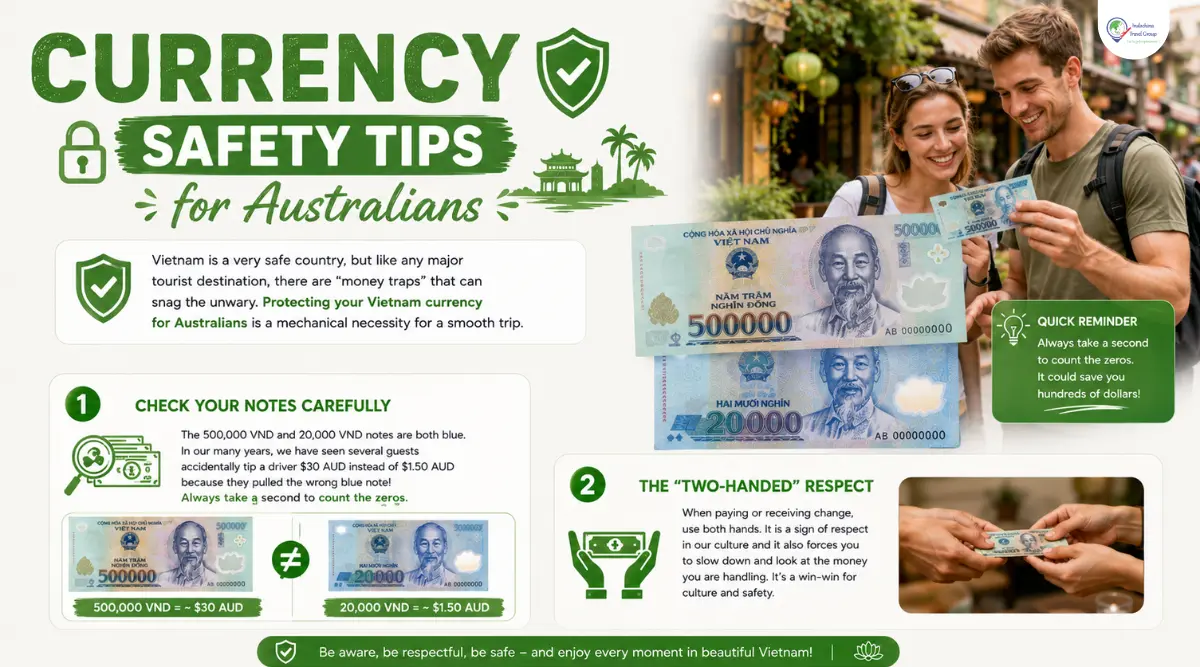 For money handling, the main preventable problems are misreading note values, losing access to a card, accepting a conversion without checking it or carrying every backup in the same place. Keep this section focused on payment risks; for theft, scams, transport and broader personal-safety planning, use our Vietnam safety guide for Australians.
Check your notes carefully
Some VND notes can look similar at a quick glance, especially when you are unfamiliar with the number of zeros. Check the denomination before handing over cash and keep larger notes separate from smaller everyday notes when that makes payment easier.Slow down when handling cash
There is no special payment ritual a visitor needs to memorise. A polite exchange is enough; the practical point is to pause, check the note value and confirm the change before putting the money away.Common money mistakes to avoid
Most money problems are avoidable: relying on one payment method, failing to check fees, carrying too much cash at once or confusing similar banknote values.Practical payment options for different situations
No payment method is best in every situation. Use the table as a starting point, then check merchant acceptance, fees and the payment options available on the day.| Travel Need | Practical option | What to check |
| Airport Arrival | Small amount of VND, ATM withdrawal or airport exchange | Compare convenience, rate and fees; prepaid transport may reduce the need for arrival cash. |
| Street Food/Markets | Cash (VND), with a card backup | Acceptance varies by vendor, so keep smaller notes without carrying unnecessary cash. |
| Hotels/Tours/Malls | Credit or debit card where accepted | Check merchant surcharge, foreign-transaction fee and currency-conversion choice. |
| City Hops (Taxis) | Reputable app-booked ride or clearly priced taxi / transfer | Confirm the fare and payment method; app and card availability vary by place. |
| Major Cash Top-ups | Bank ATM, bank or licensed exchange provider | Compare the final VND amount after fees instead of assuming one provider type is always cheaper. |
Practical AUD-to-VND checklist
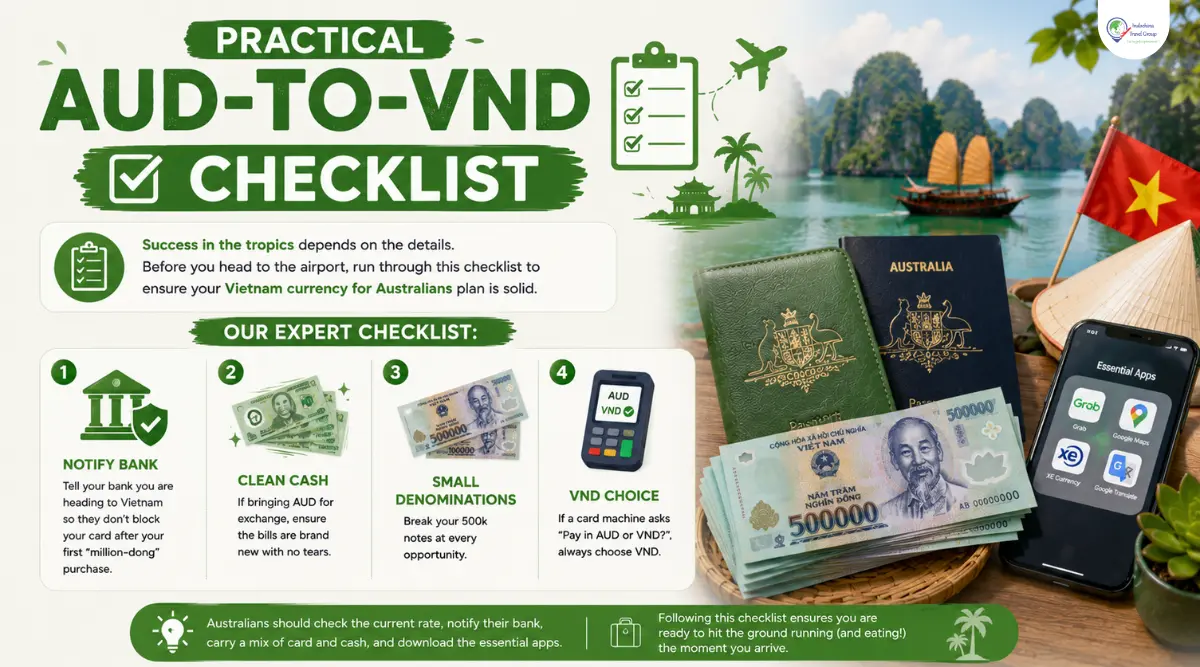 Before departure, check the payment tools you actually plan to use and keep a backup method separate from the primary wallet.
- Card settings: Check whether your bank requires a travel notice and confirm overseas transactions are enabled.
- AUD cash: If bringing cash to exchange, keep notes in good condition and confirm what denominations the exchange provider accepts.
- Small denominations: Keep some smaller VND notes for low-value purchases and check the change before leaving the counter.
- Currency conversion: If a terminal offers AUD conversion, compare the displayed rate and fees with your card provider’s conversion before choosing.
Use the Payment Method That Fits the Situation
Money planning in Vietnam becomes much easier once you can recognise the main VND notes, know when cash is more practical than card and understand the fees charged by your own bank, ATM or payment provider. Keep a backup payment method separate and check the current AUD–VND reference rate when a conversion matters.
Recommended Tours

Group Tour
Hanoi – Sapa – Danang – Ho Chi Minh 10D9N
Hanoi - Sapa - Fansipan Peak - Ninh Binh - Halong Bay Overnight On Cruise - Danang - Hoi An Ancient Town - Bana Hills - Golden Bridge - Ho Chi Minh - Cu Chi Tunnels - Mekong Delta



Private Tour
Ho Chi Minh – Cu Chi Tunnels – Mekong Delta 4D3N
Ho Chi Minh - Cu Chi Tunnels - Mekong Delta


Private Tour
Vietnam Highlights 7 Days 6 Nights Tour
Hanoi Arrival - Hanoi City Tour - Ha Long Bay Day Cruise - Fly to Da Nang - Coconut Village - Hoi An Ancient Town - Ba Na Hills - Golden Bridge - Fly to Ho Chi Minh City - Cu Chi Tunnels - Mekong Delta - Departure


5D4N DELIGHT DANANG TOUR (DANANG – BA NA HILL FRENCH VILLAGE – HOI AN – HUE CITY) (SEAT IN COACH)


Private Tour
Vietnam Panorama Discovery 16D15N
Ho Chi Minh - Cu Chi Tunnels - Mekong Delta Tour - Can Tho - Da Lat - Nha Trang - Hoi An - Da Nang - Hue - Hanoi - Halong Bay Overnight On Cruise